NC A&T Is The Black Cat That Catches Mice

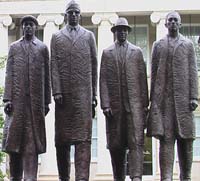 |
Legacy Of The
Greensboro Four |
 Challenger
: Challenger
:Aggie on Board ; Ten thousand students of color launch their American Dream at NC A&T |
 N.C.
A&T Awarded NSF Engineering Research Center
; N.C.
A&T Awarded NSF Engineering Research Center
; |
 In
2011 HBCU North Carolina A&T for the seventh consecutive year had the
third highest amount of research funding of the 16-member University of
North Carolina with 56 million dollars trailing only NC flag ship
universities North Carolina-Chapel Hill and N.C. State. NC A&T
technology prowess hasn't gone unnoticed on the national level. In 2006
in the category of Doctorial Granting Universities NC A&T was rated as a
High Research University in the Carnegie Foundation classification of
colleges and universities. In 2008 NC A&T received an 18 Million dollar
grant for an Engineering Research Center (ECR) from the National Science
foundation. The award to A&T marked the first time that an HBCU has been
the lead institution of an ERC. (http://www.ncat.edu/nsf_erc.html).
On
the local level “Having an engineering school in the area is enormously
important," "Just look at N.C. State with their engineering program and
what it's done for Centennial Campus in Raleigh. (Information and
engineering technology) can grow very quickly and have a near-immediate
impact on a community, unlike biotech which takes a while to develop."
That's good news for Greensboro, said Matt Crawford, managing director
at Longleaf Venture Fund."[8]
In
2011 HBCU North Carolina A&T for the seventh consecutive year had the
third highest amount of research funding of the 16-member University of
North Carolina with 56 million dollars trailing only NC flag ship
universities North Carolina-Chapel Hill and N.C. State. NC A&T
technology prowess hasn't gone unnoticed on the national level. In 2006
in the category of Doctorial Granting Universities NC A&T was rated as a
High Research University in the Carnegie Foundation classification of
colleges and universities. In 2008 NC A&T received an 18 Million dollar
grant for an Engineering Research Center (ECR) from the National Science
foundation. The award to A&T marked the first time that an HBCU has been
the lead institution of an ERC. (http://www.ncat.edu/nsf_erc.html).
On
the local level “Having an engineering school in the area is enormously
important," "Just look at N.C. State with their engineering program and
what it's done for Centennial Campus in Raleigh. (Information and
engineering technology) can grow very quickly and have a near-immediate
impact on a community, unlike biotech which takes a while to develop."
That's good news for Greensboro, said Matt Crawford, managing director
at Longleaf Venture Fund."[8]
Nanoscale science is a field of scientific investigation that
addressed the development, manipulation, and use of material and devices
on the scale of roughly 1-100 nanometers in length. Collaborative,
 interdisciplinary
approaches to research, particularly the integration of
chemistry, physics, engineering and biology, will be required to
realize the promises and opportunities of Nanoscale science. Almost
all of the occupations which will be affected by nanotechnology will
require a BS in engineering with a broad, interdisciplinary and muti-disciplinary
approach. Nanotechnology will require an understanding not only of
electrical, mechanical and civil engineering, but biology, physics
and chemistry as well. [4] The largest producer of minority
engineers in the country NC A&T and only Ph.D. HMI in North Carolina,
offers approved master's degrees in Civil Engineering, Chemistry,
Biology, Industrial Systems & Systems Engineering, Electrical
Engineering, Mechanical Engineering, Computer Science, Chemical
Engineering, Physics, Computational Science and Engineering, as well as
doctoral degrees in Energy and Environmental Systems Engineering,
computational Science and Engineering, Electrical Engineering,
Mechanical Engineering, and Industrial and Systems Engineering.
interdisciplinary
approaches to research, particularly the integration of
chemistry, physics, engineering and biology, will be required to
realize the promises and opportunities of Nanoscale science. Almost
all of the occupations which will be affected by nanotechnology will
require a BS in engineering with a broad, interdisciplinary and muti-disciplinary
approach. Nanotechnology will require an understanding not only of
electrical, mechanical and civil engineering, but biology, physics
and chemistry as well. [4] The largest producer of minority
engineers in the country NC A&T and only Ph.D. HMI in North Carolina,
offers approved master's degrees in Civil Engineering, Chemistry,
Biology, Industrial Systems & Systems Engineering, Electrical
Engineering, Mechanical Engineering, Computer Science, Chemical
Engineering, Physics, Computational Science and Engineering, as well as
doctoral degrees in Energy and Environmental Systems Engineering,
computational Science and Engineering, Electrical Engineering,
Mechanical Engineering, and Industrial and Systems Engineering.
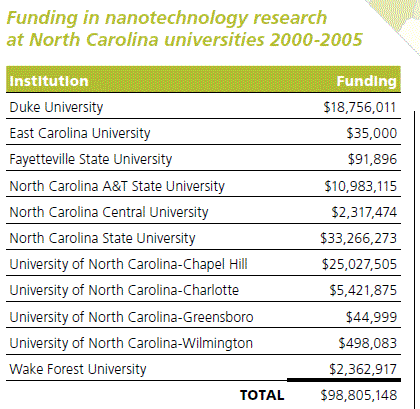
"NC A&T has a 12-year history in Nanoresearch and two centers of excellence for Nanotechnology and Nanoscience." wrote Sharlini Sankaran for NCTechnology.com and conducted over 10 million dollars of Nanoscience research between 2000-05 compared to less than 49,000 dollars by UNC-Greensboro. Source: (PDF) Findings and Strategic Imperatives of the (NC) Governor’s Task Force on Nanotechnology and North Carolina’s Economy APRIL 2006.
"NC A&T is “well known in areas such as advanced materials, nanotechnology, computational science, and engineering," says N. Radhakrishnan, (former) vice chancellor for research and economic development at N.C. A&T. The school also has significant strengths in other areas, including biotechnology, energy and the environment, information sciences and technology, logistics and transportation systems, public health, leadership, and community development. All these endeavors are aligned in eight research clusters that bring faculty together across disciplines to develop large research projects. These research clusters run in parallel with a number of multidisciplinary centers and institutes at N.C. A&T, which develop partnerships with private and corporate sponsors, educational institutions, and government agencies. This includes two US Army Centers of Excellence that are working on projects to enhance the capabilities of soldiers on the battlefield.” [7]
NCA&T State University has been funded at an average rate of $3-5 million per year in the area of Nanoscience and nanotechnology. Most of the research in Nanoengineering is done in the Center for Advanced Materials and Smart Structures (CAMSS). Several Centers and projects are under CAMSS, including the NSF Center for Research Excellence in Science and Technology (CREST), the DoD Center for Nanoscience, Nanomaterials and Multifunctional Materials (CNN) for Homeland Security, the NSF Nanoscale Science and Engineering Center (NSEC), the NSF project on US/Europe Materials Collaboration: Self-Organized Nanostructured Thin Films for Catalysis, the NSF project on Nanoscale Interdisciplinary Research Teams (NIRT), the NSF Major Research Instrumentation for Nanoengineering Research, and the NSF Nanotechnology Undergraduate Education (NUE) program. CAMSS also facilitates many of the materials research activities of the NASA-National Institute for Aerospace (NIA). In addition, the Center for Composite Materials Research (CCMR) does research in nano-enhanced. [5]
N C Agricultural & Technical State University Nanoscience Research Centers
· Center for Advanced Materials and Smart Structures
· Center for Nanoscale Chemical-Electrical-Mechanical Manufacturing Systems
· Engineering Research Center for Revolutionalizing Metallic Biomaterials
· Center for Nanoscience and Nanomaterials
· Transitioning Undergraduate Research to the Undergraduate Classroom
UNC Greensboro Nanoscience Research Centers
· Center of Research Excellence in Nanobiosciences
Source: North Carolina Board of Science and Technology
When almost all of the occupations affected by nanotechnology will require a B.S. in engineering with an understanding not only of electrical, mechanical and civil engineering, but biology, physics and chemistry as well.. And UNC-Greensboro conducted $49,000 dollars of Nanotechnology research between 2000-05 compared to $10 Million dollars at NC A&T other than white privilege why is UNC-Greensboro without even a Master’s in Physics in the Nanoscience picture?
| [1] PCG/UNC/NCCCS/HB1264UNC Final Recommendations.doc/BS.PC.3.SP.8/AP.4/CC.11/21July06 |
| [2] Nanotechnology in North Carolina, April 2007 North Carolina Biotechnology Center. |
| *[3] UNCG and NC A&T partner to create joint program in nanotechnology, Sharlini Sankaran, October 8, 2007, North Carolina Board of Science and Technology, http://www.ncnanotechnology.com/public/features/UNCG-NCAT.asp |
| [4] Description of the Doctoral Program NCAT/UNCG Request to Plan Ph.D. in Nanoscience. |
| *[5] PCG/UNC/NCCCS/HB1264UNC Final Recommendations.doc/BS.PC.3.SP.8/AP.4/CC.11/21July06 |
| [6]PCG/UNC-NCCCS/UNC Interim report 3.doc/RB.SP.PC.CR.ATPCC.1/CC.14/10May05 Page 123 |
| [7]Preliminary Recommendation A Brief Overview PCG/UNC-NCCCS/updated Findings/Recs.doc/SP.PC.2/CC.6/29December05 page6 |
| [8] PCG/UNC/NCCCS/HB1264UNC Final Recommendations.doc/BS.PC.3.SP.8/AP.4/CC.11/21July06 Page 24 |
| [9] PCG/UNC-NCCCS/UNC Interim report 3.doc/RB.SP.PC.CR.ATPCC.1/CC.14/10May05 Page 34 |
| [10] Dr. Priscilla P. Taylor s- Chairwoman UNC-BOG COMMITTEE ON EDUCATIONAL PLANNING, POLICIES, AND PROGRAMS. Minutes BOARD OF GOVERNORS MEETING The University of North Carolina May 11, 200 |
| *[11] High Research Activity, The Scientist www.the-scientist.com/2007/03/01/s31/1 |
| [12] Shannon Blosser, July 21, 2005 The Pope Center for Higher Education http://www.popecenter.org/clarion_call/article.html?id=1602 P63 |
| [13] Phyllis Palmiero,2005, Governance in the Public Interest A Case Study of the University of North Carolina System, The American Council of Trustees and Alumni, Commissioned by the John W. Pope Center for Higher Education Policy |
| *[14] Thelma J. Bryan versus The University of North Carolina 09CVS1160 |
| *[15] Funding in nanotechnology research at North Carolina universities 2000-2005 NC Board of Science and Technology |
| [17] MINUTES The University of North Carolina at Greensboro Board of Trustees Business Affairs Committee September 18, 2008 |
| [18] e-mails Ginger Burke, Associate VP Finance UNC-GA, April 9th (2009) . |
| [19] Request to
Establish NCA&T/UNCG Joint School of Nanoscience and
Nanoengineering |