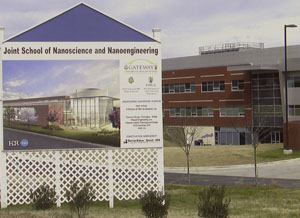
 Gateway Research Park maybe iconic of the necessity
of the Occupy Raleigh Movement. With significant
support from the Greensboro Partnership, during the 2007 legislative
session, Gateway University Research Park, Inc. was awarded $58
million(5 million as an appropriation and $53 million in COP's) for the
construction of an approximately 100,000 square foot facility for the
newly created Joint School of Nanoscience and Nanoengineering (JSNN).
Eight million ($8 million ) of the funding will be used for specialized
equipment associated with Nanoscience. UNCG
Establish, with N.C. A&T, The Joint Millennium Campus
In 2009 when an estimated 5000 teachers lost their
jobs, unemployment at an all time high and food banks at an all-time
low, the NC General Assembly appropriated $ 54 Million taxpayer dollars
to build a Joint School of Nanoscience and Nanoengineering Research
Building owned by Gateway Research Park a private corporation.
Gateway Research Park maybe iconic of the necessity
of the Occupy Raleigh Movement. With significant
support from the Greensboro Partnership, during the 2007 legislative
session, Gateway University Research Park, Inc. was awarded $58
million(5 million as an appropriation and $53 million in COP's) for the
construction of an approximately 100,000 square foot facility for the
newly created Joint School of Nanoscience and Nanoengineering (JSNN).
Eight million ($8 million ) of the funding will be used for specialized
equipment associated with Nanoscience. UNCG
Establish, with N.C. A&T, The Joint Millennium Campus
In 2009 when an estimated 5000 teachers lost their
jobs, unemployment at an all time high and food banks at an all-time
low, the NC General Assembly appropriated $ 54 Million taxpayer dollars
to build a Joint School of Nanoscience and Nanoengineering Research
Building owned by Gateway Research Park a private corporation.| In addition to fraud and corruption, the 1.4 Billion dollars plus question representing potential loss of UNC Federal research and Title IV funding, has University of North Carolina - the legal name of the unelected 32 member NC Board of Governors (UNC BOG) - with statutory supervision of the 16 constituent public | |
| universities
n the UNC-System implemented
segregationist policies of
discrimination, separate and unequal dual system of education,
and denial of equal protection with authorization of MS and PhD
Nanoscience degree to cross-town HWI UNC Greensboro via the
Joint School of Nanoscience and Nanoengineering (JSNN) at
fraudulent alleged statutory (NC. GS. §
116-198.34.(8b)) designated Joint Millennium campus Gateway Research Park, Inc, requiring Nanoscience students be given the opportunity to take courses at the School of Engineering at HBI North Carolina A&T University ( NCA&T) and be able to work on collaborative projects with faculty in the School of Engineering when established UNC Policy Academic Program Planning and Evaluation pertaining to Interdisciplinary Degrees 400.1.1 [R] that says “ if more than one campus is involved in offering the program it would also be a joint degree”. Excluding HMI NC A&T from offering Nanoscience degrees which established UNC Policy says should be joint degrees, UNC BOG discriminated , denied due process, equal protection to the university, depriving it of enrollment growth funding, degree credit, and benefit of prior appropriations for Nanoscience faculty as it facilitated cross town |
 |
|
PCG/UNC-NCCCS/UNC Interim report 3.doc/RB.SP.PC.CR.ATPCC.1/CC.14/10May05 Page 34 |
|
 |
|
|
UNCG 2006-07 Academic Profile Source : www. UNCG. edu |
|
 |
|
|
Regulations for Academic Program Planning and Evaluation UNC Policy Manual 400.1.1[R] |
|
 |
|
|
Alleged UNCG Revised MS Nanoscience Request |
|
 |
|
|
GA questions to NCA&T/UNCG with Campus response and GA responses |
|
 |
|
|
Degrees - Amended and Restated Management Agreement (April 24, 2009) |
|
| HWI Liberal Arts UNCG use HBI NC A&T’s curriculum, faculty, and research, to establish competitive Nanoscience program. | |
 HBI
North Carolina Agricultural and Technical State University (NCA&T) and
HWWI University of North Carolina Greensboro (UNCG) submitted Joint NCAT/UNCG
Requests to Establish Masters (date 01.29.09) and Ph.D. (date
12.15.08) interdisciplinary Nanoscience degrees pursuant a JSNN
Management Agreement ( March 03, 2008) a formal agreement to
offer a program of study required by UNC policy for
interdisciplinary degrees, Regulations for Academic Program Planning
and Evaluation which called for joint Nanoscience degrees. The
Erskine Bowles- UNC-General Administration (UNC-GA) referencing a
document titled Joint Program Reporting Requirements dated 12/1/08
informed NCA&T and the UNCG the original Memorandum Agreement between
the two institutions...is contrary to methods now recommended by
General Administration. As such, the Memorandum (Management
Agreement) from March 3, 2008 needs to be revised, updated, and
reapproved, tabling without consideration by BOG NCAT/UNCG Request’s to
Establish Joint Masters (dated 01.29.09) and PhD (dated 12.15.08)
interdisciplinary Nanoscience degrees. The UNC-BOG subsequently
authorized stand alone Masters ( dated Nov. 2009) and PhD ( dated Jan.
2010) interdisciplinary Nanoscience degrees at UNC-G
non-compliant with UNC Guidelines for Academic Program Development and
Regulations for Academic Program Planning and Evaluation pertaining to
Interdisciplinary Degree programs which says “ If more than one
campus is involved in offering the program it would also be a joint
degree.” based on a UNC-GA revised, updated, and reapproved
Amended and Restated Management Agreement ( April 24, 2008) which
said UNCG would offer Nanoscience degrees and NCA&T would offer
Nanoengineering degrees. The M.S. and Ph,D. degree
authorizations were based on an unsigned alleged UNCG
revised request” to establish a Professional Masters in Nanoscience
created and submitted by Dr. James Ryan, an UNCG & NC A&T employee who
may have acted outside the scope of his employment, to Dr.
James Sadler Associate Vice President for Academic Planning (GA)
that was placed in the discipline file. Summaries from the Rynan
document was taken to BOG by the Bowles-UNC-GA. with recommendations to
establish at UNCG stand -alone M.S. and Ph.D. in Nanoscience,
non-compliant with UNC Policy. Repeated request to UNCG to responded to
whether Dean Ryan was acting with-in the scope of his employment in the
creation and submission of document to Dr. Sadler have not been
responded to.
HBI
North Carolina Agricultural and Technical State University (NCA&T) and
HWWI University of North Carolina Greensboro (UNCG) submitted Joint NCAT/UNCG
Requests to Establish Masters (date 01.29.09) and Ph.D. (date
12.15.08) interdisciplinary Nanoscience degrees pursuant a JSNN
Management Agreement ( March 03, 2008) a formal agreement to
offer a program of study required by UNC policy for
interdisciplinary degrees, Regulations for Academic Program Planning
and Evaluation which called for joint Nanoscience degrees. The
Erskine Bowles- UNC-General Administration (UNC-GA) referencing a
document titled Joint Program Reporting Requirements dated 12/1/08
informed NCA&T and the UNCG the original Memorandum Agreement between
the two institutions...is contrary to methods now recommended by
General Administration. As such, the Memorandum (Management
Agreement) from March 3, 2008 needs to be revised, updated, and
reapproved, tabling without consideration by BOG NCAT/UNCG Request’s to
Establish Joint Masters (dated 01.29.09) and PhD (dated 12.15.08)
interdisciplinary Nanoscience degrees. The UNC-BOG subsequently
authorized stand alone Masters ( dated Nov. 2009) and PhD ( dated Jan.
2010) interdisciplinary Nanoscience degrees at UNC-G
non-compliant with UNC Guidelines for Academic Program Development and
Regulations for Academic Program Planning and Evaluation pertaining to
Interdisciplinary Degree programs which says “ If more than one
campus is involved in offering the program it would also be a joint
degree.” based on a UNC-GA revised, updated, and reapproved
Amended and Restated Management Agreement ( April 24, 2008) which
said UNCG would offer Nanoscience degrees and NCA&T would offer
Nanoengineering degrees. The M.S. and Ph,D. degree
authorizations were based on an unsigned alleged UNCG
revised request” to establish a Professional Masters in Nanoscience
created and submitted by Dr. James Ryan, an UNCG & NC A&T employee who
may have acted outside the scope of his employment, to Dr.
James Sadler Associate Vice President for Academic Planning (GA)
that was placed in the discipline file. Summaries from the Rynan
document was taken to BOG by the Bowles-UNC-GA. with recommendations to
establish at UNCG stand -alone M.S. and Ph.D. in Nanoscience,
non-compliant with UNC Policy. Repeated request to UNCG to responded to
whether Dean Ryan was acting with-in the scope of his employment in the
creation and submission of document to Dr. Sadler have not been
responded to.
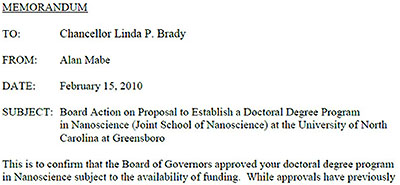
BOG subsequently authorized stand-alone M.S. and Ph.D. interdisciplinary Nanoscience degrees at the University of North Carolina-Greensboro (UNCG) described as a historical white women Liberal Arts University based on an unsigned purported UNCG Revised proposal, created by Dr. James Ryan - an UNCG & NCA&T employee who may have acted outside the scope of his employment- that was submitted to the Dr. James Sadler (GA). Non-compliant with UNC Guidelines for Academic Program Development (B). summaries of the Ryan proposal containing Bowles GA recommendations to establish M.S. and Ph.D. Nanoscience degrees at UNCG were submitted to the BOG. BOG authorized UNCG M.S. and Ph.D. Nanoscience degrees incorporated provisions Nanoengineering degrees will be awarded by NCA&T and Nanoscience degrees will be awarded by UNCG which doesn’t comply with Regulations for Academic Program Planning and Evaluation pertaining to Interdisciplinary Degree programs “ if more than one campus is involved in offering the program it would also be a joint degree.” Excluding NCA&T from offering Nanoscience degrees and may deprive it of enrollment growth funding, degree credit, and benefit of prior appropriations for Nanoscience faculty, etc. While allowing cross town HWU UNCG to use NCA&T’s curriculum, research, faculty, to establish competitive Nanoscience program at UNCG.
UNC Guidelines for Academic Program Development subsection (B). Academic Program Development Requiring Authorization or Action Beyond the Campus Level, states:
The chancellors of the constituent institutions shall communicate to General Administration of the University their intentions with respect to instructional program development:
- Notification of intent to plan a new undergraduate or master's program
- Request for authorization to plan a new degree program at the doctoral or first professional level.
- Request for authorization to establish a new degree program.
UNC Policy Manual 400.1.1,1[G] amended 05/06/09 http://www.northcarolina.edu/aa_planning/degrees/index.htm
Checking UNC-BOG website (northcarolina.edu) Nanoscience Discipline file it lacks documentation supporting authorizations of MS and PhD at UNCG required by Regulations for Academic Program Planning and Evaluation (B) which prompted this investigative report into the authorizations of MS and PhD in Nanoscience at Liberal Arts UNCG. Examining the Nanoscience discipline files http://www.northcarolina.edu/dpanels_archive/index.php (CIP 40.9999):
1. The discipline file lacked an UNCG Notification to plan a master’s in Nanoscience,
2. The discipline file contained an unsigned “Revised UNCG Request to Establish a Master’s in Nanoscience,
3. The discipline file lacked an UNCG Request to plan a PhD in Nanoscience
4. The discipline file lacked an UNCG Request to Established a PhD in Nanoscience
which prompted this investigation.
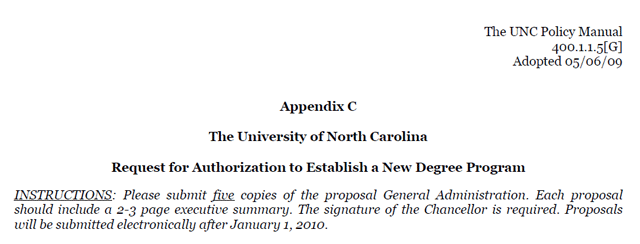
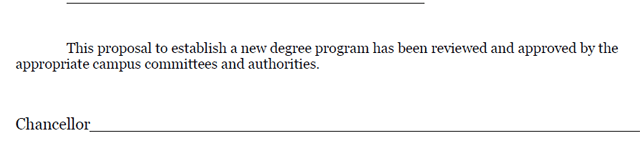
 The Nanoscience discipline filed
lacked an UNCG Chancellor signed request to establish stand alone UNCG
M.S and Ph.D. in Nanoscience. A. Public Record Request (PRR) to
Dr. David H. Perrin UNCG Provost & Executive Vice Chancellor,1/7/11, for
a copy of an UNCG chancellor signed request to establish stand alone
Masters and PhD Nanoscience degrees at UNCG, Counsel Steve Serck
responded "In response to your request of 1/7/11, no such documents
as you described exists." (Emphasis added). UNCG Chancellors Dr.
Linda Brady signature was required pursuit Guidelines for Academic
Program Development subsection (B) certifying the proposal to establish
a M.S. and Ph.D. Nanoscience degree programs had been reviewed and
approved by the appropriate campus committees and authorities and lack
thereof demonstrates the degree authorizations weren't pursuant UNC
established procedures.
The Nanoscience discipline filed
lacked an UNCG Chancellor signed request to establish stand alone UNCG
M.S and Ph.D. in Nanoscience. A. Public Record Request (PRR) to
Dr. David H. Perrin UNCG Provost & Executive Vice Chancellor,1/7/11, for
a copy of an UNCG chancellor signed request to establish stand alone
Masters and PhD Nanoscience degrees at UNCG, Counsel Steve Serck
responded "In response to your request of 1/7/11, no such documents
as you described exists." (Emphasis added). UNCG Chancellors Dr.
Linda Brady signature was required pursuit Guidelines for Academic
Program Development subsection (B) certifying the proposal to establish
a M.S. and Ph.D. Nanoscience degree programs had been reviewed and
approved by the appropriate campus committees and authorities and lack
thereof demonstrates the degree authorizations weren't pursuant UNC
established procedures.Early in the investigation of lack of supporting documentation for UNCG Nanoscience degree authorizations Dr. James Sadler Associate Vice President for Academic Planning University of North Carolina put forth a chronology of authorizations (e-mail (08/04/2010). In part:
October 7, 2009
Dean Ryan was told that UNCG needed to submit a revised request to
establish. Both the original and the revised requests are available
at this site: http://www.northcarolina.edu/dpanels_archive/index.php.
Emphasis added
November 13, 2009
UNC Board of Governors authorizes the UNCG MS in Nanoscience based on
the revised request submitted. The summary that went to the Board
can be viewed in the Planning Committee pre-meeting materials at this
location: https://www.northcarolina.edu/bog/index.php. Emphasis added
December 9, 2009
UNC Graduate Council recommends authorization of the joint PhD.
Emphasis added
January 8, 2010
UNC Board of Governors authorizes the UNCG PhD in Nanoscience based
on the revised request submitted. The summary that went to the
Board can be viewed in the Planning Committee pre-meeting materials at
this location: https://www.northcarolina.edu/bog/index.php. Emphasis
added
Public Record requests to Dr. David H. Perrin and Dr. James Ryan revealed Dr. James Ryan, an UNCG& NCA&T employee, created a PDF titled Nano_master's_degree_proposal_-_Revised_10-9-09.pdf and submitted it to Dr. James Sadler Associate Vice President for Academic Planning University of North Carolina dated two days after a Videoconference panel discussion of the proposed M.S. in Nanoscience, Oct. 7, 09. Dr. Ryan’s Nano_master's_degree_proposal_-_Revised_10-9-09.pdf the same/similar to the UNCG Revised Proposal in the Master of Science in Nanoscience (MS) discipline file at www.northcarolina.edu.
From: James C. Sadler
Date: Sun, Oct 11, 2009 at 10:07 AM
Subject: Re: Revised version of the Request to Establish the
Professional Master of Science in Nanoscience degree program
To: James Ryan CC dhprrin,
JCPETER, altont,
kmurray
Thanks Jim, I’ll confer with Alan about the Ph.D. and whether anything it needed. Jim Sadler
James Ryan wrote:
I have attached a revised version of the Request to Establish for the Professional Master of Science in Nanoscience. I have included the most recent update of the JSNN Management Agreement as well as revised figures on enrollment. I have also provided additional explanation to address questions that were asked during the disciplinary committee review on Wednesday. Please review and let me know if additional information or clarification is needed. Also, similar revisions are needed for the Request to Establish the Ph.D. in Nanoscience. Should I send the latest version of that document to you as well? Thank you. Jim
Nanoscience degrees are interdisciplinary subject to additional requirements under Regulations for Academic Program Planning and Evaluation: Interdisciplinary Degree program:
An Interdisciplinary Degree program involves two or more academic units, either on the same or different campuses, including non-UNC campuses, in a formal agreement to offer a program of study drawing on two or more disciplines that will result in a student being awarded an interdisciplinary degree. If more than one campus is involved in offering the program it would also be a joint degree.HBCU North Carolina Agricultural and Technical State University (NCA&T) and HWWU University of North Carolina Greensboro (UNCG) submitted Joint NCAT/UNCG Requests to Establish Masters, dated 01.29.09, and Ph.D. , dated 2.15.08, interdisciplinary Nanoscience degrees based in a JSNN Management Agreement ( March 03, 2008) a formal agreement to offer a program of study required by UNC policy for interdisciplinary degrees, Regulations for Academic Program Planning and Evaluation in which Nanoscience Master’s and PhD degrees would be joint. The Erskine Bowles- UNC-General Administration (GA) referencing a document titled Joint Program Reporting Requirements dated 12/1/08 informed NCA&T and the UNCG the original Memorandum Agreement between the two institutions...is contrary to methods now recommended by General Administration. As such, the Memorandum (Management Agreement) from March 3, 2008 needs to be revised, updated, and reapproved, tabling without consideration by BOG NCAT/UNCG Request’s to Establish Joint Masters and PhD interdisciplinary Nanoscience degrees. Pursuant NC Public records laws the Joint Program Reporting Official Rules and Procedures were requested "To the best of my knowledge, there is no such document." said, Ms. Joni Worthington Vice President for Communications UNC-GA (E-mail 10.08.10)

“Steve has managed the discussion with A&T's and UNCG's provost and the dean of the JSNN so that all issues have been resolved." said Dr. Harold Martin, Sr. (April 9, 2009). Notwithstanding the dictates of UNC Policy on Regulations for Academic Program Planning and Evaluation Interdisciplinary degrees involving two or more campuses being joint degrees the Bowles-UNC-GA managed revised, updated, and re-approved JSNN Management Agreement (April 24, 2009) excluded HBU NCA&T from joint interdisciplinary Nanoscience degrees with an organization principle Nanoscience degrees will be awarded by UNCG and Nanoengineering degrees will be awarded by NCA&T, an operating principle adopted in the BOG established in the stand -alone M.S. and Ph.D. in Nanoscience at UNCG.
The BOG authorized Masters ( Nov. 2009) and PhD (Jan. 2010) interdisciplinary Nanoscience degrees at the University of North Carolina Greensboro (UNCG) and in Jan. 2011 authorized a MS interdisciplinary Nanoengineering at NC A&T at Gateway Research Park which also didn’t follow Guidelines for Academic Program Development subsection (B.)
UNC Guidelines for Academic Program Development subsection (B). Academic Program Development Requiring Authorization or Action Beyond the Campus Level, says:
The chancellors of the constituent institutions shall communicate to General Administration of the University their intentions with respect to instructional program development:
- Notification of intent to plan a new undergraduate or master's program
- Request for authorization to plan a new degree program at the doctoral or first professional level.
- Request for authorization to establish a new degree program.
UNC Policy Manual 400.1.1,1[G] amended 05/06/09
The Chancellor doesn't sign "Requests to Establish" or "Requests to Plan". Responded NCA&T Counsel Charles Waldrup for a Chancellor signed NC A&T Request to Establish a Masters in Nanoengineering because there wasn’t one in the discipline file.
The Tom Ross UNC-GA carried a request to Plan a MS to the Board of Governors which wasn’t compliant with UNC Guidelines for Academic Program Development subsection (B) which was authorized.
The BOG authorize a M.S. in Nanoengineering at NCA&T Feb. 2011 subsequent to the UNCG Nanoscience authorizations with the same/similar intended audience (A) and objectives (B) potential creating the constitutional ban dual education program - HWU UNCG Nanoscience (white) and HVU NCA&T Nanoengineering. Did BOG Created dual system of Education: Nanoscience at HWWU UNCG and Nanoengineering at HBCU NCA&T compare A&B:
UNCG: A. Describe the proposed degree program (i.e., its nature, scope, and intended audience).
The Professional Master of Science in Nanoscience is designed for students with strong backgrounds in either science or engineering who seek additional specialized training to qualify them for positions in Nanoscience or nanotechnology development or manufacturing companies.
NCAT: A. Describe the proposed degree program (i.e., its nature, scope, and intended audience).
Master of Science in Nanoengineering is designed for students with strong backgrounds in either engineering or science who seek additional specialized education and training to qualify them for positions in the field of Nanoengineering or nanotechnology design, research and development, or manufacturing.
UNCG: B. List the educational objectives of the program.
The proposed Professional Master of Science in Nanoscience degree program’s objective is to produce graduates who are prepared to directly enter private enterprise activities in nanoscale commercialization, manufacturing and business.
NCAT: B. List the educational objectives of the program.
The proposed Professional Master of Science in Nanoscience degree program’s objective is to produce graduates who are prepared to directly enter private enterprise activities in nanoscale commercialization, manufacturing and business.
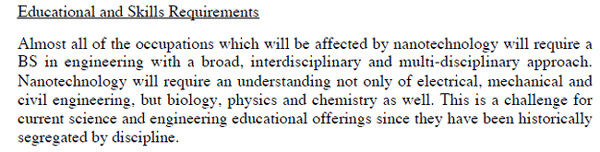
In that NCA&T’s foot print in Nanotechnology is more pronounced than HWU UNCG. “The degree is in Nanoscience (and does not include nanoengineering), students will be given the opportunity to take relevant courses at the School of Engineering at North Carolina A&T University and will be able to work on collaborative projects with faculty in the School of Engineering.” [4] How could NCA&T build a creditable distinctive competitive Nanoengineering program supporting UNCG Ph.D. Nanoscience access to its School of Engineering, faculty and research, etc - the foundation of any Nanoengineering program? When almost all of the occupations affected by nanotechnology will require a B.S. in engineering other than white privilege why is Liberal Arts UNCG in the Nanoscience picture.
The BOG maybe discriminating by excluding NCA&T from offering Nanoscience degrees when UNCG Nanoscience degrees are predicated on the “students … given the opportunity to take relevant courses at the School of Engineering at NCA&T and be able to work on collaborative projects with faculty in the School of Engineering”.[6] which Regulations for Academic Program Planning and Evaluation, interdisciplinary says if more than one campus is involved in offering the program it would also be a joint degree, facilitating cross town HWU Liberal Arts UNCG use of HBU NCA&T’s faculty, curriculum, research, to establish competitive Nanoscience program at UNCG. The Billion dollars plus figure represent the amount of Federal research in play if the university found to have discriminated.
|
Degree Authorization Summary |
||||||||||||||||||||||||||||||||||||||||||
|
| [1] PCG/UNC/NCCCS/HB1264UNC Final Recommendations.doc/BS.PC.3.SP.8/AP.4/CC.11/21July06 |
| [2] Nanotechnology in North Carolina, April 2007 North Carolina Biotechnology Center. |
| *[3] UNCG and NC A&T partner to create joint program in nanotechnology, Sharlini Sankaran, October 8, 2007, North Carolina Board of Science and Technology, http://www.ncnanotechnology.com/public/features/UNCG-NCAT.asp |
| [4] Description of the Doctoral Program NCAT/UNCG Request to Plan Ph.D. in Nanoscience. |
| *[5] PCG/UNC/NCCCS/HB1264UNC Final Recommendations.doc/BS.PC.3.SP.8/AP.4/CC.11/21July06 |
| [6]PCG/UNC-NCCCS/UNC Interim report 3.doc/RB.SP.PC.CR.ATPCC.1/CC.14/10May05 Page 123 |
| [7]Preliminary Recommendation A Brief Overview PCG/UNC-NCCCS/updated Findings/Recs.doc/SP.PC.2/CC.6/29December05 page6 |
| [8] PCG/UNC/NCCCS/HB1264UNC Final Recommendations.doc/BS.PC.3.SP.8/AP.4/CC.11/21July06 Page 24 |
| [9] PCG/UNC-NCCCS/UNC Interim report 3.doc/RB.SP.PC.CR.ATPCC.1/CC.14/10May05 Page 34 |
| [10] Dr. Priscilla P. Taylor s- Chairwoman UNC-BOG COMMITTEE ON EDUCATIONAL PLANNING, POLICIES, AND PROGRAMS. Minutes BOARD OF GOVERNORS MEETING The University of North Carolina May 11, 200 |
| *[11] High Research Activity, The Scientist www.the-scientist.com/2007/03/01/s31/1 |
| [12] Shannon Blosser, July 21, 2005 The Pope Center for Higher Education http://www.popecenter.org/clarion_call/article.html?id=1602 P63 |
| [13] Phyllis Palmiero,2005, Governance in the Public Interest A Case Study of the University of North Carolina System, The American Council of Trustees and Alumni, Commissioned by the John W. Pope Center for Higher Education Policy |
| *[14] Thelma J. Bryan versus The University of North Carolina 09CVS1160 |
| *[15] Funding in nanotechnology research at North Carolina universities 2000-2005 NC Board of Science and Technology |
| [17] MINUTES The University of North Carolina at Greensboro Board of Trustees Business Affairs Committee September 18, 2008 |
| [18] e-mails Ginger Burke, Associate VP Finance UNC-GA, April 9th (2009) . |
| [19] Request to
Establish NCA&T/UNCG Joint School of Nanoscience and
Nanoengineering |