|
|
 Bleeding
out taxpayers, alleged
JMC
Gateway
Research Park maybe icon for Occupy Raleigh
and University of North Carolina Board of
Governors.
In
2009 when an estimated 5000
teachers lost their jobs, unemployment at Bleeding
out taxpayers, alleged
JMC
Gateway
Research Park maybe icon for Occupy Raleigh
and University of North Carolina Board of
Governors.
In
2009 when an estimated 5000
teachers lost their jobs, unemployment at
|
 an all time
high and food banks at an all-time low, the
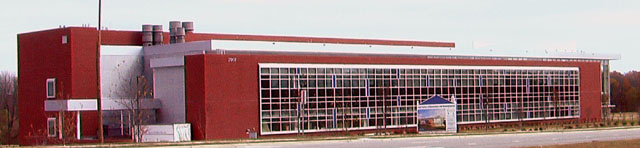
alleged Joint Millennial Campus received $
49,274.294 taxpayer dollars to build a Joint
School of Nanoscience and Nanoengineering
Research Building owned by private corporation
Gateway Research Park. Inc.
Millennial
Campuses Financing Act. NCGS § 116-198.31
dictates no pledge of taxes or the faith and
credit of the State or any agency or political
subdivision thereof, to pay the cost, in whole
or part, of buildings, structures, or other
facilities.
The sources of funds used to repay the $10
million authorized in 2004 for the Joint
Millennial Campus were the Health and Wellness
Trust Fund (HWTF) and the Tobacco Trust Fund (TTF).
The session law (SL 2004-179) that authorized
the use of debt for
the JMC also required the HWTF and TTF to pay
the debt service on this project as well as
nine other health and education projects and up
to five and youth development facilities.
Although these two trust funds have been
abolished, the same source of funds (Master
Settlement Agreement- MSA) that used to support
them is still being used for debt service. The
State’s General Fund is being used to repay the
debt service on the Joint Graduate School of
Nanoscience and Nanoengineering Building.
For more information, you
can look up the bill that created this funding
on the General Assembly’s website at
www.ncleg.net.
NC A&T Photo an all time
high and food banks at an all-time low, the
alleged Joint Millennial Campus received $
49,274.294 taxpayer dollars to build a Joint
School of Nanoscience and Nanoengineering
Research Building owned by private corporation
Gateway Research Park. Inc.
Millennial
Campuses Financing Act. NCGS § 116-198.31
dictates no pledge of taxes or the faith and
credit of the State or any agency or political
subdivision thereof, to pay the cost, in whole
or part, of buildings, structures, or other
facilities.
The sources of funds used to repay the $10
million authorized in 2004 for the Joint
Millennial Campus were the Health and Wellness
Trust Fund (HWTF) and the Tobacco Trust Fund (TTF).
The session law (SL 2004-179) that authorized
the use of debt for
the JMC also required the HWTF and TTF to pay
the debt service on this project as well as
nine other health and education projects and up
to five and youth development facilities.
Although these two trust funds have been
abolished, the same source of funds (Master
Settlement Agreement- MSA) that used to support
them is still being used for debt service. The
State’s General Fund is being used to repay the
debt service on the Joint Graduate School of
Nanoscience and Nanoengineering Building.
For more information, you
can look up the bill that created this funding
on the General Assembly’s website at
www.ncleg.net.
NC A&T Photo |
| |
|
|
| Action item
background information timeline from Feb. 2003 through
Feb2, 2006 didn't indicated a JMC of was designed by
UNC BOG. Action Item background information says " in
order to facilitate the GCID ability to perform its role
as managed/developer it was determined by counsel for
the universities and the GCID to pursue a master lease
for the properties identified as the JMC. " by
university counsels, GCID, and General
Administration. And " purpose of this action is to
request approval from this Board to proceed with a
50-year ground lease ( and two successive 10 year
renewals) with the GCID on land owned by the State of
North Carolina (Approximately 75 acres with 142,000
square feet of existing space at the former Central
North Carolina School for the Deaf and approximately 75
acres adjacent to the NCA&T farm).... . Identified JMC
An alleged lease of
an Identified JMC in which the former school of the Deaf
was depicted as a North Campus and 75 acres adjacent to
NC A&T farmland depicted as a South Campus, collectively
dominated Joint Millennial Campus portrade as 2000
Legislature GS 116 198.33(4b) designated joint
Millennial Campus and existing improvements by the
Hannan Cage Board of Governors Committee on Budget and
Finance and Bowles administration in order to secure the
legislative funding appropriated to a Joint
Millennial Campus over to the Greensboro Center for
Innovative Development- renamed Gateway Research Park. |
 |
|
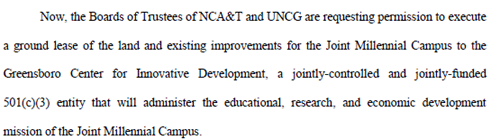
Feb. 2, 2006,
Action Item: Lease Agreement between the Greensboro
Center for Innovative Development and UNCG and NC A&T |
 |
|
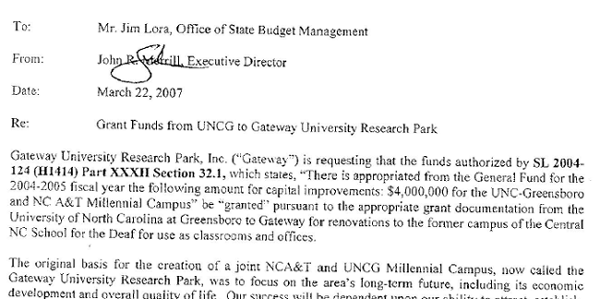
Appendix
C Lease of Joint Millennial Campus – North Carolina A&T
State University and The University of North Carolina at
Greensboro (May 2006) |
 |
| |
|
The
Centennial Campus, the Horace Williams Campus, and the
Millenial Campuses Financing Act. (Article 21B.) NC G.S.
116 198.33(8b) says in part:
That
designation (millennial Campus) shall be based on an
express finding by the Board of Governors that the
institution desiring to create a "Millennial Campus" has
the administrative and fiscal capability to create and
maintain such a campus...the Board of Governors may
authorize two or more constituent institutions which
meet the requirements of this section to create a joint
Millennial Campus.
Phillips Committee
determined the campuses had the administrative and
fiscal capacity that was required and the activities to
be performed on the Joint Millennial Campus" |
 GS
§ 116-198.31. Purpose of Article. GS
§ 116-198.31. Purpose of Article.
The purpose of this Article is to authorize the Board of
Governors of The University of North Carolina to issue
revenue bonds, payable from any leases, rentals,
charges, fees, and other revenues but with no pledge of
taxes or the faith and credit of the State or any agency
or political subdivision thereof, to pay the cost, in
whole or part, of buildings, structures, or other
facilities for the Centennial Campus, located at North
Carolina State University at Raleigh, for the Horace
Williams Campus located at the University of North
Carolina at Chapel Hill, and for any Millennial Campus
as defined by G.S. 116-198.33(4b). (1987, c. 336, s. 1;
1999-234, s. 3; 2000-177, ss. 3, 4.) § 116-198.32.
Credit and taxing power of State not pledged; statement
on face of bonds. Revenue bonds issued as in this
Article provided shall not be deemed to constitute a
debt or liability of the State or any political
subdivision thereof or a pledge of the faith
and credit of the State or of any such political
subdivision, but shall be payable solely from the funds
herein provided there for from revenues. |
| |
 |
| |
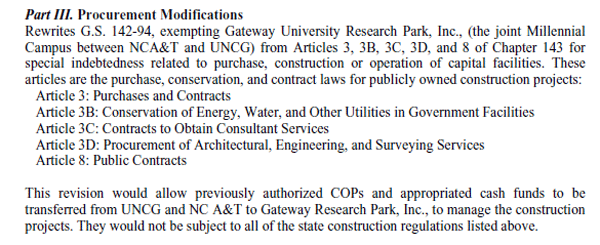
UNC Nonappropriated Capital Projects. Senate
Bill 1925 (First Edition) |
| |
 |
| |
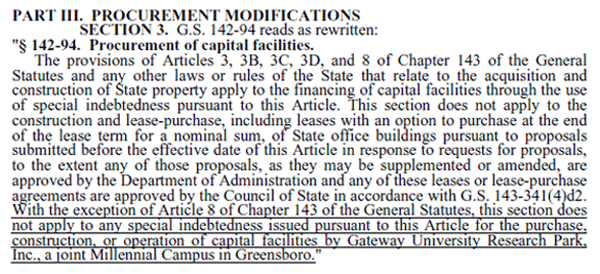
SESSION
LAW 2008-204 [SENATE BILL 1925] |
|
|
|
|
|
|
| |
 |
|
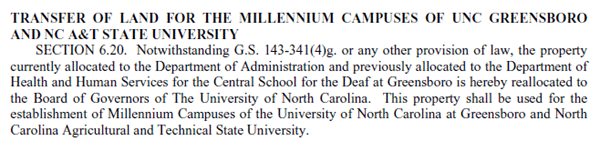
Session Law 2003-2984 |
 |
|
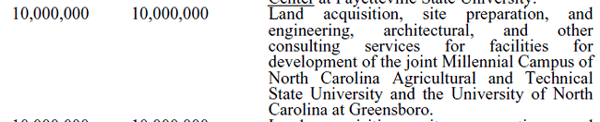
Session Law 2004-179 |
|
|
|
Session Law 2005-276 |
 |
| |
 |
|
Session Law 2007-323 |
 |
|
SL2008-0107 |
 |
|
SL2009-0451 |
|
|
|
FY 2007-08 |
$1,400,000
|
Recurring |
|
FY 2008-09 |
$1,500,000
|
Recurring |
|
|
$1,500,000
|
Non-Recurring |
|
FY 2009-10 |
$1,000,000
|
Recurring |
|
FY 2010-11 |
$1,000,000
|
Recurring |
|
TOTAL |
$6,400,000 |
|
|
|
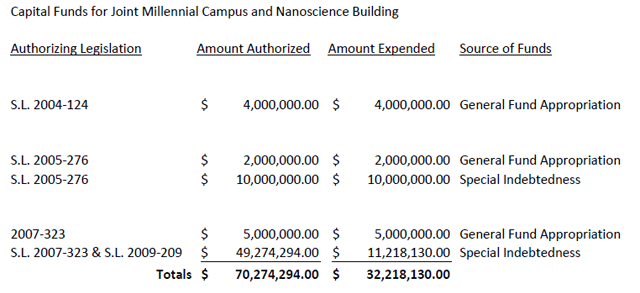
In addition, the legislature has authorized the
following capital funding for the project:
·
In FY 2004-05, the legislature authorized $3.8 million in
self-liquidating bonds (that is, bonds whose interest and principal is
intended to be fully paid with the revenue that the project generates.
In this case, the revenue was from a private gift.).
·
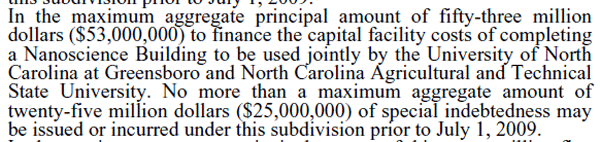
In FY 2007-08, the legislature provided $53 million of
authorization for COPS; this amount was reduced to $49,274,294 in the FY
2009-10 budget because interests rates had been lower than expected.
·
Also in FY 2007-08, the budget included $5 million in cash
for capital costs associated with the project; typically, case
appropriations such as this are for expenses such as planning and site
development, but I cannot say with certainty that that was the intent.
Fiscal
Research Division
North Carolina General Assembly
|