 In
2003-04, with the backbone of North Carolina's industrial economy
Tobacco, Textiles, and Furniture in recession and appropriations for
UNC-System taking an ever increasing multi-billion dollar bite out of
state's coffers, North Carolina's Legislature thru House Bill 1264 (HB
1264) direct UNC-BOG to contract a private consulting firm that had
experience in higher education to conduct a comprehensive
study (HB 1264 Study) of the
mission and educational program needs to ensure that the State's
citizens are academically prepared and equipped for current job
opportunities and jobs of the future in North Carolina's growing
knowledge economy. In
2003-04, with the backbone of North Carolina's industrial economy
Tobacco, Textiles, and Furniture in recession and appropriations for
UNC-System taking an ever increasing multi-billion dollar bite out of
state's coffers, North Carolina's Legislature thru House Bill 1264 (HB
1264) direct UNC-BOG to contract a private consulting firm that had
experience in higher education to conduct a comprehensive
study (HB 1264 Study) of the
mission and educational program needs to ensure that the State's
citizens are academically prepared and equipped for current job
opportunities and jobs of the future in North Carolina's growing
knowledge economy. |
|
Staying a step ahead
stated North Carolina A&T State
University is well positioned to grow programs in some of the areas
identified as emerging industries, citing Objective 2.2: Increase access
to University intellectual property and resources (faculty, students,
research. Create market-oriented university research clusters to better
communicate research programs. |
|
Identified Emerging Markets
[4] |
[4][
examples of research clusters created by NC A&T are the following: |
-
Advanced Manufacturing
-
Advanced Materials, including Chemicals,
Plastics and Nanotechnology
-
Biotechnology and Pharmacology
-
Computing, Software and the Internet
-
Design and Arts
-
Logistics and Distribution
|
-
Public Health
-
Biotechnology, Bio & Food Sciences
-
Advanced Materials & Nanotechnology
-
Computational Science & Engineering
-
Leadership & Community Development
-
Information Sciences & Technology
-
Transportation & Logistics
-
Energy & Environment]
|
| |
|
|
Biotechnology and
Nanotechnology Should have been NC A&T Signature Programs |
|
It is predicted that
nanoscale science will change the nature of almost every human-made
product this century. This field has great potential applications
in materials, medicine, electronics, optics, data storage, advanced
manufacturing, environment, energy, and national security. Some specific
applications include: lightweight new materials with greatly improved
strength and wear characteristics; ultra dense computer memory; better
drug design and better drug and gene delivery; sensing applications for
agricultural, biological, chemical and homeland security applications;
improved catalysts for the chemical and automotive industries; new
materials to improve fuel economy and carbon dioxide emissions; and
improved batteries and energy efficient processes for energy
technologies. Nanoscale materials already find use in numerous
pharmaceutical, catalytic, electronic, magnetic, optoelectronic,
biomedical, cosmetic and energy applications. |
| |
| HB 1264(6)
recognized the Historic significance of Historical
Minority Institutions (HMI), ordered the University to formulate
signature programs at them and not to diminish their role. The study
stated " “Signature programs” have been defined as those that are
distinctive, that build on existing strengths, that advance the
institution’s profile, and that serve regional and/or state economic
transformation needs."
"NC A&T has a 12-year history in nanoresearch
and two centers of excellence for nanotechnology and nanoscience." [3]].
Expertise in nanotechnology may
become a prerequisite for many scientists and engineers that support a
wide variety of industries, nano expertise among the North Carolina
science and engineering workforce may soon become a competitive
advantage issue for the state."
"
Almost all of the occupations which will be affected by nanotechnology
will require a BS in engineering with a broad, interdisciplinary and
multi-disciplinary approach; require an understanding not only of
electrical, mechanical
and civil engineering, but biology, physics and chemistry
as well."
[5].
NC A&T’s engineering and
technology prowess hasn't gone unnoticed on the national level. In 2006
in the category of Doctorial Granting Universities NC A&T was rated as
a High Research University in the Carnegie Foundation classification of
colleges and universities. In 2008 NC A&T received an 18 Million
dollar grant for an Engineering Research Center (ECR) - N.C. A&T Awarded
NSF Engineering Research Center foundation. The award to A&T marked the
first time that an HBCU has been the lead institution of an ERC.
NC A&T the
largest producers of minority engineers in the country and only PhD HMI
in North Carolina, offers approved master's degrees in Civil
Engineering, Chemistry, Biology, Industrial Systems & Systems
Engineering, Electrical Engineering, Mechanical Engineering, Computer
Science, Chemical Engineering, Physics, Computational Science and
Engineering, as well as doctoral degrees in Energy and Environmental
Systems Engineering, computational Science and Engineering,
Electrical Engineering, Mechanical Engineering, and Industrial and
Systems Engineering.
Aggie Pride |
 NC
A&T is "well known in areas such as advanced materials,
nanotechnology, computational
science, and says
N. Radhakrishnan, former for research and economic development
at N.C. A&T. The school also has significant strengths in other
areas, including biotechnology, energy and the environment,
information sciences and technology, logistics and
transportation development. All these endeavors are aligned
in eight NC
A&T is "well known in areas such as advanced materials,
nanotechnology, computational
science, and says
N. Radhakrishnan, former for research and economic development
at N.C. A&T. The school also has significant strengths in other
areas, including biotechnology, energy and the environment,
information sciences and technology, logistics and
transportation development. All these endeavors are aligned
in eight |
|
    |
| |
"We're not following the
path we're blazing the trail" |
|
research clusters that bring
faculty together across disciplines to
develop
large research projects.
These research clusters run in parallel
with a number of multidisciplinary centers and institutes at
N.C. A&T, which develop partnerships with private and corporate
sponsors, educational institutions, and government agencies.
This includes two US Army Centers of Excellence that are working
on projects to enhance the capabilities of soldiers on the
battlefield. [3]
|
| |
|
In 2011 HMI North
Carolina A&T, largest producers of minority engineers and
technologists in the country, holds patents in Advanced
Materials, Nanotechnology, Biotechnology, Computational Science,
Environmental Sciences, Transportation Systems, and Public
Health, for seventh consecutive year achieved the third
highest research funding in the 16-constituent University of
North Carolina System with over $60 million dollars. |
|
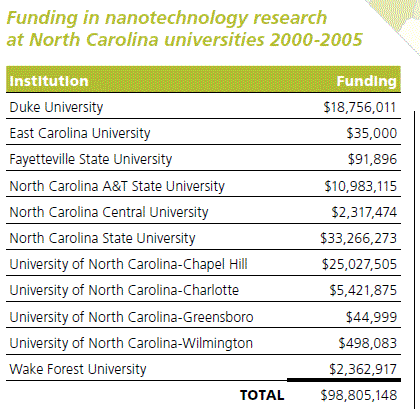
Nanotechnology in North
Carolina 2007 |
|
North Carolina
A&T Nano Centers |
-
Center for Advanced Materials and Smart Structures
-
Center for Nanoscale Chemical-Electrical-Mechanical
Manufacturing Systems
-
Engineering Research
Center for Revolutionalizing Metallic Biomaterials
-
Center for Nanoscience and Nanomaterials
|
|
UNC at
Greensboro Nanoscience Centers |
-
Center of Research
Excellence in Nanobiosciences
|
|
Source: North Carolina Board of Science and Technology |
|
| |
|
|
|
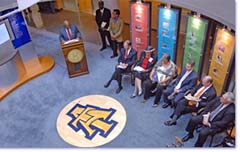
 NC
A&T Engineering Research Center on the Move -Globally NC
A&T Engineering Research Center on the Move -Globally
Sept. 2008 NC A&T won an 18 Million dollar grant for an Engineering
Research Center (ECR) - N.C. A&T Awarded NSF Engineering Research Center
foundation. The award to A&T marked the first time that an HBCU has been
the lead institution of an ERC.
"With
the millions of federal dollars flowing to this center, what we
can do to increase the economic opportunities in Guilford County, the
Triad and in the state of North Carolina is truly phenomenal," said
Erskine Bowles , president of the UNC system. [A&T lands prized NSF
center][31]. Who's "we" ? NC A&T State University
|
|
[was] awarded a
grant for an Engineering Research Center (ERC) from the National
Science Foundation (NSF). Engineering Research Center grants are
among the most prestigious NSF awards, and they represent major
investments by NSF in partnership with industry to transform
engineering research and education. The centers aim to produce
innovative technologies and engineering graduates to
significantly enhance the competitiveness of the U.S. economy.
The NSF ERC for Revolutionizing Metallic Biomaterials at A&T
will conduct research in the areas of biomedical engineering
and nano-bio applications and is in partnership with the
Universities of Cincinnati and Pittsburgh. It also
has a global technical partner in Germany’s Hannover
School of Medicine and a global cultural and outreach
partner in the Indian Institute of Technology, Madras, India.
California State University at Los Angeles will serve as an
outreach partner in the USA. The ERC has partnerships with
pre-college institutions in North Carolina to involve teachers
and students in engineering; it has partnerships with a
broad range of North Carolina organizations devoted to
entrepreneurship and small business development. " " “NSF
is delighted to welcome A&T to the ERC program as lead
institution,” said Lynn Preston, a deputy division director at
NSF and leader of the Engineering Research Centers Program. “The
unique vision of this ERC to carry out research on new |
 |
|
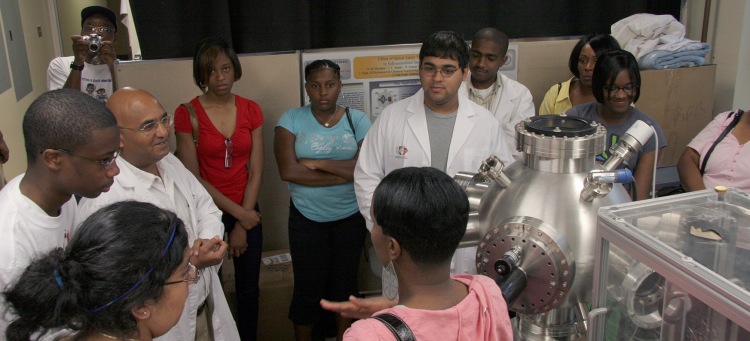
High school students see the pulsed laser deposition
system in an ERC laboratory NC A&T Photo |
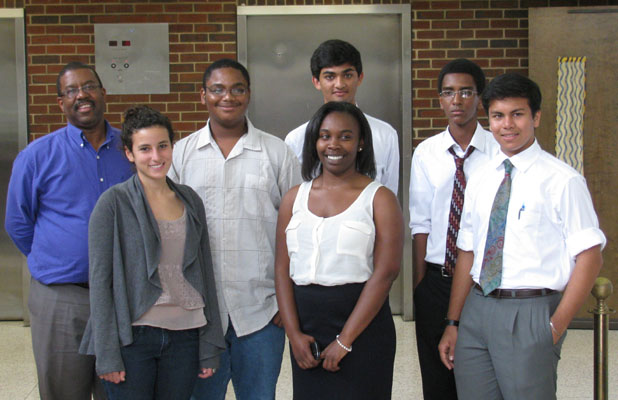 HIGH
SCHOOL STUDENTS SPEND SIX WEEKS AS BIOENGINEER-ING RESEARCHERS HIGH
SCHOOL STUDENTS SPEND SIX WEEKS AS BIOENGINEER-ING RESEARCHERS
|
|
implant technologies
for controlled use of degradable metallic implants offers
significant opportunities for regenerative medicine for children
and adults.” Preston expects that the partnerships designed into
this ERC will produce important exchanges of knowledge and
capabilities among the ERC partner universities in the U.S. and
abroad, and that they will significantly enhance our ability
to advance this technology and develop graduates who can become
leaders in innovation in the global marketplace. “This
ERC’s educational programs will significantly impact the
diversity of the engineering workforce because of its location
at A&T and its synergistic partnership with the new A&T
department of bioengineering,” Preston added. “We look forward
to the pre-college partnerships in this ERC attracting a broadly
diverse group of students to engineering and medicine.”
'The award represents an investment by the NSF in partnership
with industries to create centers that focus on engineering
research at universities across the country ...More than eight
companies will be associated with the A&T center to provide
input for the direction of the research and help transition the
technology into the real world...GTCC also will implement a
two-year degree program to transition students into A&T's
Engineering Research Center ....The research center is expected
to have a large impact on the local and state economy by
producing high paying jobs and increasing the state's
competitive-ness when research industries consider locating here
..." 3 |
|
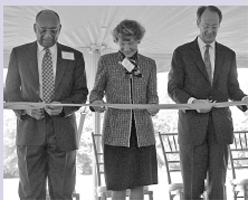 “The
world is seeing explosive growth today in the
commercialization of nanotechnology. We will have all
of the assets right here in Guilford County that
we need to participate in that explosion, and they will
be right here at the Gateway University Research
Park." said Erskine Bowles, president of the
University of North Carolina system .
[1] “The
world is seeing explosive growth today in the
commercialization of nanotechnology. We will have all
of the assets right here in Guilford County that
we need to participate in that explosion, and they will
be right here at the Gateway University Research
Park." said Erskine Bowles, president of the
University of North Carolina system .
[1]
" The
joint school will build on the nanotechnology research
activity established at nearby Wake Forest and at NCA&T.
[2] |
|
|
|
|
In 2011 HMI North Carolina A&T, largest producers of minority
engineers and technologists in the country, holds patents in
Advanced Materials, Nanotechnology, Biotechnology,
Computational Science, Environmental Sciences, Transportation
Systems, and Public Health, for seventh consecutive year
achieved the third highest research funding in the 16-member
University of North Carolina System with over $60 million
dollars. “Federal
grants make up the bulk of A&T's research funding."[30].
Orchestrating
commercialization
of federal research the manner and means assets at NC A&T came
to be located at alleged joint Millennial Campus Gateway
Research Park and who benefitted
is subject of this
Statement of the Case.
[A&T lands prized NSF center] "With the millions of federal
dollars flowing to this center, what we can do to increase the
economic opportunities in Guilford County, the Triad and in the
state of North Carolina is truly phenomenal," said Erskine
Bowles , president of the UNC system. [A&T lands prized NSF
center][31]. Local media reported "
Wilbur L. Ross Jr., a billionaire
financier and the country's newest textile industry baron, plans
to invest more money in nanotechnology companies.
"
[32
The
Mission
Statement of The University of North Carolina unambiguous is
teaching, learning, and research in the most cost effective
manner - not commercialization.
|
|
|
Greensboro Attorney, UNC BOG Chairman Jim Phillips, Jr. at the Sept.
2006 UNC-BOG board meeting suggested delegation to the President
(Bowles) certain tasks what he termed as operation issues within the
University, that historically were acted on in the committee setting.
Phillips would say “in fact, during this past session of the General
Assembly, this board was specifically authorized to delegate such
things, as we deemed appropriate.” The board as part of the University
of North Carolina 2006 Non-Budget Legislative Agenda requested it be
allowed to delegate statutory duties to the President. UNC-BOG
(11.13.2006) authorized authority previously held by UNC-BOG to the
President (Bowles) may have created a Higher Education Czar with iron
grip on the university with the: |
|
·
Authority to
appoint and set the salaries of Senior Academic and Administrative and
other employees exempt from the State Personnel Act serving with the UNC
General Administration.
·
Authority to set salary ranges
for Senior Academic and Administrative officers of the constituent
institution of university.
·
Authority to
approve conferrals of tenure and to set salaries of faculty, Senior
Academic and Administrative officers, except the chancellors, and other
employees exempt from the State Personnel Act at campuses etc....
|
| |
|
Governance in the Public Interest: A Case Study of the University of
North Carolina System , determined “ The Board spends substantial
amounts of time on activities that should be transferred to the
institutional boards of trustees, thus leaving more time for the Board
to focus on system-wide concerns such as improving academic quality,
assessing student learning, and better managing costs. The Board too
often uses the consent agenda for issues deserving more debate such as
program approval, property acquisition, and mission review. And:
·
The long-range strategic
plan is staff-driven, not Board-driven.
·
The Board sometimes uses
academic freedom to excuse questionable academic judgments. [9]
·
By its own acknowledgment,
the Board does not concentrate on cost control as much as it should
Citing “under the current system, the campus boards of trustees have
relatively little authority over their institutions and virtually no
input into the hiring, firing, and compensation of senior staff.. [P63]
Phyllis
Palmiero, June 2005, for the American Council of Trustees and Alumni
Commissioned by the John W. Pope Center for Higher Education Policy. |
| There are 15
or more members on the Board of Governors from UNC-Chapel Hill and none
from North Carolina A&T or other HBCUs within the system, clearly
equality and respect has not been shown to A&T by the system. A&T Board
of Trustee [34] |
| February 1970 the
University of North Carolina (System) received notice of its
non-compliance with Title VI from HEW's Office for Civil Rights . [33]
The board of trustees of the University of North Carolina were
redesignated, effective July 1, 1972, as the 'Board of Governors of the
University of North Carolina.' The Higher Education Reorganization Act
of 1971, placed those 16 institutions under one governing board, in
doing so the Legislature may have only organized non-compliance by
placing people who have been the source of non-compliance in the same
room and given them control - old dogs don't learn new tricks. |
| Like
it is : Proposed UNC Tomorrow Statewide Nano Network
collaboration between UNC institutions involved in
nanotechnology and Nanoscience excludes NC A&T and NC Central. |
 |
|
UNC Tomorrow maybe a continuation of UNC
Yesterday |
|
"NC A&T has a
12-year history in nanoresearch and two centers of excellence
for nanotechnology and nanoscience, and" Nanotechnology research
at NC A&T has been funded at a rate of $3 to $5 million per
year." UNCG and NC A&T partner to create joint program in
nanotechnology October 8, 2007 By Sharlini Sankaran, http://www.ncnanotechnology.com/public/features/UNCG-NCAT.asp |
|
|
Felony
Fraud, Grand Thief and receiving property under false pretense |
| |
| UNC
Board of Governors big white lie: NCAT/UNCG
Joint Millennial Campus (JMC) constitute classic tell a lie loud and
long enough by alleged creditable News Sources it becomes accepted as
truth. University of North
Carolina |
| Board of
Governors (UNC BOG) designation of NCA&T/UNCG Joint Millennial Campus
(JMC) pursuant NCGS§ 116-198.34.(8a.)(8b) - didn’t happen !!! In
violation of S. L. 2003-2984 section 6.20 Transfer of Land for the
Millennium Campuses of UNC Greensboro and NC A&T State University, May
2006 UNC Board of Governors (herein UNC BOG) approved ground lease of
the land and existing improvements for alleged Joint Millennial Campus
which had not been designated Pursuant NC GS 116-198.34. (8b) to the
Greensboro Center for Creative development, Inc. -- renamed Gateway
Research Park, Inc., placed on the consent agenda by UNC President
Erskine Bowles Administration fraudulent alleging in October 2003 the
Boards of Trustees of North Carolina A&T State University and The
University of North Carolina at Greensboro requested, and the Board of
Governors approved, the designation of the land (formerly the
Central School for the Deaf) 2003 Session of the General Assembly and
a ted and existing facilities. |
 |
- Don't exist
responded UNC-General Administration to Public Record request for
UNC-Board of Governors authorization establishing NCA&T/UNCG Joint
Millennial Campus
- We can not locate
Board of Governors authorization establishing Joint Millennial
Campus- NC A&T
- After a diligent
search, I can report that we are not in possession of copies of any
documents whereby the UNCG Board of Trustees made a request for
permission to execute a ground lease, as requested in paragraph 4 of
your letter (copy attached). UNC at Greensboro Request reply.
(4) UNCG Board of Trustees request for permission to execute a
ground lease of the land and existing improvements for joint
Millennial Campus to the Greensboro Center for Innovative
Development to UNC Board of Governors.
|
| 75-acre
parcel of land currently comprising a portion of the NC A&T State
University Farm as a Joint Millennial Campus which UNC BOG has never
designa |
| |
|
Jim Phillips
Board of Governors Committee on
Budget and Finance |
|
Published at
www.northcarolina.edu speaking
before Board of Governors, Committee on Budget and Finance
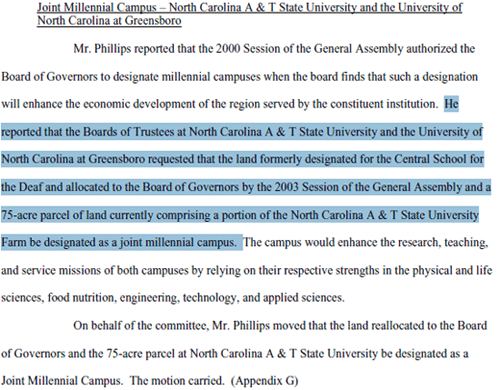
Chair Greensboro Attorney Jim W. Phillips, Jr. reported "The
Boards of Trustees of North Carolina A&T State University and
The University of North Carolina at Greensboro had requested
that the Board of Governors designate the land (formerly the
|
Central School for the Deaf) reallocated to
the
Board of Governors by the 2003 Session of the General Assembly
and a 75 acre parcel of land currently comprising a portion of
the NCA&T State University Farm as a Joint Millennial Campus."
which was subsequently approved Oct. 10, 2003 by UNC BOG.
Published at
www.northcarolina.edu
before Committee on Budget and Finance, The Boards of Trustees
of North Carolina A&T State University and The University of
North Carolina at Greensboro had requested that the Board of
Governors designate the land (formerly the Central School for
the Deaf) reallocated to the Board of Governors by the 2003
Session of the General Assembly and a 75 acre parcel of land
currently
comprising a portion of the NCA&T
State University Farm as a Joint Millennial
Campus. The President had completed the required
consultations and recommended that the Board approve the
request. The campuses had the administrative and fiscal
capacity that was required and the activities to be performed on
the Joint Millennial Campus It was recommended that the land
reallocated to
|
 |
|
the Board of Governors and the 75-acre parcel
at North Carolina A&T State University be designated as a Joint
Millennial Campus. On the motion of Ms. Gage, seconded by
Governor Holshouser, the recommendation was approved.
Published as "the most
plugged-in attorney in North Carolina",
Unambiguous alleged
Chairman Phillips statements pertaining to a Joint Millennial
Campus in terms of a 75-acre portion of NC A&T farmland
doesn't Gee -haw with alleged NC A&T August 22nd and UNCG 28th
Resolutions calling for designation of Joint Millennial Campus
in terms of the School for the Deaf property without a
syllable pertaining to a
parcel or portion of NC A&T farmland, statutory
foreclosing NC A&T/UNCG Joint Millennial Campus
. |
|
| |
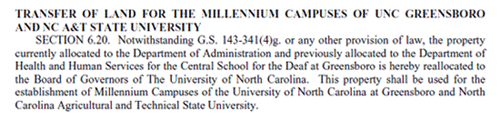
June 30, 2003 General Assembly reallocated former Central School
of the Deaf to UNC BOG to be used for the establishment of
Millennium campuses of the University of North Carolina at
Greensboro and North Carolina Agricultural and Technical State
University which Board of Governors' Committee on Budget and
Finance recommended on July 28, 2003.
|
 |
|
Session Law 2003-2984 |
|
| |
Documents received pursuant public records
request from UNCG for Request to Establish Joint Millennial
Campus, university resolutions allege NC A&T
and
UNCG
Board of Trustees Resolutions dated , Aug. 22 2003 and
Aug. 28, 2003 call for designation of Joint Millennial Campus
in terms of the Central North Carolina School of the Deaf
transferred to UNC Board of Governors for the purpose of
establishing a Joint
Millennial Campus and nonprofit corporation be the entity be
designated to accept School for the Deaf without a
syllable pertaining to a
parcel or portion of NC A&T farmland.
NC GS: 116-198.34.
(8b) says Upon formal request by the constituent
institutions, the Board of Governors may authorize two or more
constituent institutions which meet the requirements of this
section to create a joint Millennial Campus, statutory
foreclosing NC
A&T/UNCG Joint Millennial Campus in terms of “designation
of the land (formerly the Central
School for
the Deaf) reallocated
to the Board of Governors by the 2003
Session of the General
Assembly and a 75-acre parcel of land currently comprising a
portion of the NC A&T State University Farm as a Joint
Millennial Campus.” depicted
in
Appendix_ G_-_Joint_Millennial_Campus and
Lease of Joint Millennial Campus
document.
"The second half of
the project will take place on 75 acres along East Lee Street.
A&T has
|
 |
|
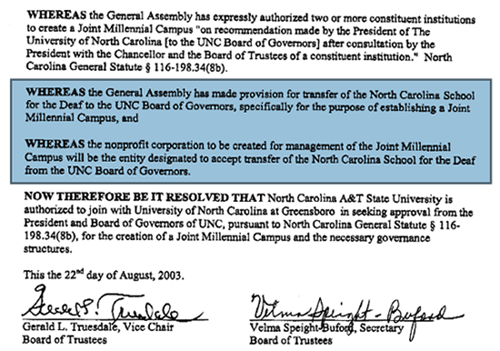
Alleged NC A&T
University Board of Trustees Resolution dated August 22, 2003
vote may have taken place at an informal gathering at Stoney
Creek Golf Club rather than a BOT Meeting. NC A&T 2002-03
State Audit Report list Velma Speight Buford as Vice Chair
instead of Secretary as signed on the resolution. Records
received from NC A&T recording secretary indicate non sworn new
board members participated in alleged resolution vote.
|
 |
|
NC A&T 2003 First Regular Board of Trustees Meeting took place
Sept. 24, 2003 where new board members were sworn in and
officers elected. At
the first meeting after June 30 of each year, the Board of
Trustees shall elect from its membership a Chair, a Vice Chair
and a Secretary. (See G.S. 116-32) |
offered
up a portion of its 600-acre farm for the research
park." A&T, UNCG UNVEIL PLANS FOR JOINT CAMPUSES, JOHN
NEWSOM, Greensboro News & Record (NC) - Wednesday,
September 24, 2003. "As to your prior request for
the resolution/motion about the 75 acres of land being a
part of the Gateway Research Park, There is no 2003
resolution, etc. that specifically says 75 acres are
involved." determined J. Charles Waldrup J.D., Ph.D.
General Counsel Office
|
 |
|
NC A&T Board of
Trustees Meeting April 16, 2003 |
|
|
Of Legal Affairs
North Carolina Agricultural & Technical State University.
Whether NC A&T Board of Trustees' alleged August 22nd, 2003
Resolution requesting establishing a joint Millennial Campus in
terms of the Central School of the Deaf property is valid,
unmistakable having been informed by Chancellor Renick that
members of the Board of Trustees plan to meet informally with
UNCG about the possibility of establishing a joint millennial
campus on the farm property, NC A&T BOT August 22nd resolution
explicably rejected farm property as part of a joint millennial
campus. |
| |
|
| |
|
See Joint
Millennial Campus (JMC) |
| The 1.4 Billion dollars
plus question representing potential loss of UNC Federal research and
Title IV funding, has University of North Carolina - the legal name of
the unelected 32 member NC Board of Governors (UNC BOG) - with
|
statutory
supervision of the 16 constituent public universities
in the UNC-System implemented
segregationist policies of discrimination, separate and unequal dual
system of education, and denial of equal protection with authorization
of MS and PhD Nanoscience degree to cross-town HWI UNC Greensboro via
the Joint School of Nanoscience and Nanoengineering (JSNN) at fraudulent
alleged statutory (NC. GS. § 116-198.34.(8b)) designated Joint
Millennium
campus Gateway Research Park,
Inc, requiring Nanoscience students be given the opportunity to take
courses at the School of Engineering at HBI North Carolina A&T
University ( NCA&T) and be able to work on collaborative projects with
faculty in the School of Engineering when established UNC Policy
Academic Program Planning and Evaluation pertaining to Interdisciplinary
Degrees 400.1.1 [R] that says “ if more than one campus is involved in
offering the program it would also be a joint degree”. Excluding HMI
NC A&T from offering Nanoscience degrees which established UNC Policy
says should be joint degrees, UNC BOG discriminated , denied due
process, equal protection to the university, depriving it of
enrollment growth funding, degree credit, and benefit of prior
appropriations for |
 |
|
NCA&T/UNCG Joint MS & PHD
Nanoscience Request |
 |
|
Regulations for Academic Program Planning and Evaluation
The UNC Policy Manual 400.1.1[R] Adopted o5/06/09 |
 |
|
Request to Plan Joint PhD in
Nanoscience - Description |
 |
|
Alleged UNCG Revised MS
Nanoscience Request |
 |
|
Degrees - Management
Agreement March 3, 2008 |
 |
|
GA questions to NCA&T/UNCG
with Campus response and GA responses |
 |
|
Degrees - Amended and
Restated Management Agreement (April 24, 2009) |
| Nanoscience faculty
as it facilitated cross
town HWI Liberal Arts UNCG use HBI NC A&T’s curriculum, faculty, and
research, to establish competitive Nanoscience program.
SEE De
Jure Segregation |
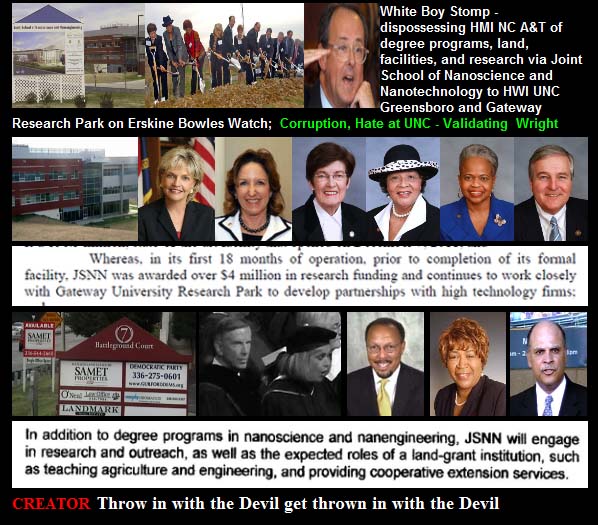 Repackaging
Jim Crow for the 21st Century as collaboration and economic development,
fifty plus years after February 1, 1960 when four HMI North Carolina
Agricultural & Technical State University (NCA&T) freshmen sat down at
Woolworth's lunch counter projecting Greensboro, NC onto national and
international stage with the sit-in movement, serving private interest
at public expense, members of the Greensboro business community and
Guilford County Legislative delegation, working through UNC Board of
Governors, UNC Office of the President, University officials and
legislature maybe - implementing De jure segregation and Racketeering -
diverting state appropriations and facilities, federal research, and
degree programs via the Joint School of Nanoscience and Nanotechnology
to UNC at Greensboro and fraudulent alleged Joint Millennial Campus
private education corporation Gateway Research Park, Inc whereby NC
A&T's research and academic offerings are transferred and accessed by
HWI UNC Greensboro and commercialized by Gateway Research Park, Inc.
- Validating Rev. Jeremiah
Wright alleged " put them outside equal protection of the law".
Repackaging
Jim Crow for the 21st Century as collaboration and economic development,
fifty plus years after February 1, 1960 when four HMI North Carolina
Agricultural & Technical State University (NCA&T) freshmen sat down at
Woolworth's lunch counter projecting Greensboro, NC onto national and
international stage with the sit-in movement, serving private interest
at public expense, members of the Greensboro business community and
Guilford County Legislative delegation, working through UNC Board of
Governors, UNC Office of the President, University officials and
legislature maybe - implementing De jure segregation and Racketeering -
diverting state appropriations and facilities, federal research, and
degree programs via the Joint School of Nanoscience and Nanotechnology
to UNC at Greensboro and fraudulent alleged Joint Millennial Campus
private education corporation Gateway Research Park, Inc whereby NC
A&T's research and academic offerings are transferred and accessed by
HWI UNC Greensboro and commercialized by Gateway Research Park, Inc.
- Validating Rev. Jeremiah
Wright alleged " put them outside equal protection of the law".




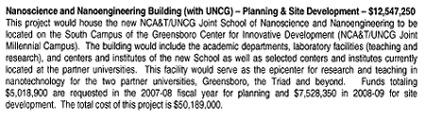
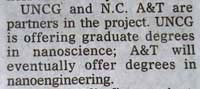 "A&T
will eventually offer degrees in nanoengineering" reported Jonnelle
Davis ( Nano, money No.1 on A&T, UNC-G list News & Record 10.04.2010) -
member on the Greensboro Partnership Board - as UNC-Greensboro began
offering stand alone interdisciplinary M.S. and PhD degrees in
Nanoscience in 2010 through Gateway Research Park supported by required
classes in Nanostructure Materials and Engineering applications,
Microelectronics Fabrication Technology, and Thin Film Technology for
Device Fabrication, etc offered at A&T, non compliant with UNC Policy
Academic Program Planning and Evaluation pertaining to Interdisciplinary
Degrees 400.1.1 [R] that says “ if more than one campus is involved in
offering the program it would also be a joint degree”,
"A&T
will eventually offer degrees in nanoengineering" reported Jonnelle
Davis ( Nano, money No.1 on A&T, UNC-G list News & Record 10.04.2010) -
member on the Greensboro Partnership Board - as UNC-Greensboro began
offering stand alone interdisciplinary M.S. and PhD degrees in
Nanoscience in 2010 through Gateway Research Park supported by required
classes in Nanostructure Materials and Engineering applications,
Microelectronics Fabrication Technology, and Thin Film Technology for
Device Fabrication, etc offered at A&T, non compliant with UNC Policy
Academic Program Planning and Evaluation pertaining to Interdisciplinary
Degrees 400.1.1 [R] that says “ if more than one campus is involved in
offering the program it would also be a joint degree”,