Did UNC-Greensboro
submit fraudulent Nanoscience Prospectus to SACSCOC which determines
eligibility for Student Aid?
Angels Gathered Here: Stating the Case
Michael J. Pippen, Sr., Black Triad News Com
Overview of University of North Carolina UNCG M.S. and Ph.D. Nanoscience authorizations Fig. 1
 HBU
North Carolina Agricultural and Technical State University (NCA&T) and
HWWU University of North Carolina Greensboro (UNCG) submitted Joint NCAT/UNCG
Requests to Establish Masters (date 01.29.09) and Ph.D. (date
12.15.08) interdisciplinary Nanoscience degrees pursuant a JSNN
Management Agreement ( March 03, 2008) a formal agreement to
offer a program of study required by UNC policy for
interdisciplinary degrees, Regulations for Academic Program Planning
and Evaluation. The Erskine Bowles- UNC-General Administration (UNC-GA)
referencing a document titled Joint Program Reporting Requirements
dated 12/1/08 informed NCA&T and the UNCG the original Memorandum
Agreement between the two institutions...is contrary to methods now
recommended by General Administration. As such, the Memorandum
(Management Agreement) from March 3, 2008 needs to be revised, updated,
and reapproved, tabling without consideration by BOG NCAT/UNCG Request’s
to Establish Joint Masters (01.29.09) and PhD (12.15.08)
interdisciplinary Nanoscience degrees. The UNC-BOG subsequently
authorized stand alone Masters ( dated Nov. 2009) and PhD ( dated Jan.
2010) interdisciplinary Nanoscience (CIP 40.9999) degrees at UNC-G
non-compliant with UNC Guidelines for Academic Program Development and
Regulations for Academic Program Planning and Evaluation pertaining to
Interdisciplinary Degree programs which says “ If more than one
campus is involved in offering the program it would also be a joint
degree.” based on a UNC-GA revised, updated, and reapproved
Amended and Restated Management Agreement ( April 24, 2008) which
said UNCG would offer Nanoscience degrees and NCA&T would offer
Nanoengineering degrees. Degree authorizations were based
on an unsigned alleged UNCG revised request” to establish a
Professional Masters in Nanoscience created and submitted by Dr. James
Ryan, an UNCG & NC A&T employee who may have acted outside the scope of
his employment, to Dr. James Sadler Associate Vice President
for Academic Planning (GA) that was placed in the discipline file.
Summaries from the Rynan document was taken to BOG by the Bowles-UNC-GA.
with recommendations to establish at UNCG stand -alone M.S. and Ph.D. in
Nanoscience, non-compliant with UNC Policy.
HBU
North Carolina Agricultural and Technical State University (NCA&T) and
HWWU University of North Carolina Greensboro (UNCG) submitted Joint NCAT/UNCG
Requests to Establish Masters (date 01.29.09) and Ph.D. (date
12.15.08) interdisciplinary Nanoscience degrees pursuant a JSNN
Management Agreement ( March 03, 2008) a formal agreement to
offer a program of study required by UNC policy for
interdisciplinary degrees, Regulations for Academic Program Planning
and Evaluation. The Erskine Bowles- UNC-General Administration (UNC-GA)
referencing a document titled Joint Program Reporting Requirements
dated 12/1/08 informed NCA&T and the UNCG the original Memorandum
Agreement between the two institutions...is contrary to methods now
recommended by General Administration. As such, the Memorandum
(Management Agreement) from March 3, 2008 needs to be revised, updated,
and reapproved, tabling without consideration by BOG NCAT/UNCG Request’s
to Establish Joint Masters (01.29.09) and PhD (12.15.08)
interdisciplinary Nanoscience degrees. The UNC-BOG subsequently
authorized stand alone Masters ( dated Nov. 2009) and PhD ( dated Jan.
2010) interdisciplinary Nanoscience (CIP 40.9999) degrees at UNC-G
non-compliant with UNC Guidelines for Academic Program Development and
Regulations for Academic Program Planning and Evaluation pertaining to
Interdisciplinary Degree programs which says “ If more than one
campus is involved in offering the program it would also be a joint
degree.” based on a UNC-GA revised, updated, and reapproved
Amended and Restated Management Agreement ( April 24, 2008) which
said UNCG would offer Nanoscience degrees and NCA&T would offer
Nanoengineering degrees. Degree authorizations were based
on an unsigned alleged UNCG revised request” to establish a
Professional Masters in Nanoscience created and submitted by Dr. James
Ryan, an UNCG & NC A&T employee who may have acted outside the scope of
his employment, to Dr. James Sadler Associate Vice President
for Academic Planning (GA) that was placed in the discipline file.
Summaries from the Rynan document was taken to BOG by the Bowles-UNC-GA.
with recommendations to establish at UNCG stand -alone M.S. and Ph.D. in
Nanoscience, non-compliant with UNC Policy.
Accreditation Determines Eligibility for Title IV Funds
“When an institution has earned accreditation by the Commission on Colleges, it signifies that it has "a purpose appropriate to higher education and has resources, programs, and services sufficient to accomplish and sustain that purpose." In addition to ensuring that our institutions provide quality programs for students which determines eligibility for Title IV funds (student financial aid), the Commission on Colleges works to influence legislation and regulations that impact the work of our member institutions.” Belle S. Wheelan, Ph.D. President Southern Association of Colleges and Schools Commission http://www.sacscoc.org/president.asp
SACSCOC Standards
The Principle of Integrity
“Integrity, essential to the purpose of higher education, functions as the basic contract defining the relationship between the Commission and each of its member and candidate institutions. It is a relationship in which all parties agree to deal honestly and openly with their constituencies and with one another. Without this commitment, no relationship can exist or be sustained between the Commission and its accredited and candidate institutions.”
The Commission on Colleges expects integrity to govern the operation of institutions and for institutions to make reasonable and responsible decisions consistent with the spirit of integrity in all matters. Therefore, evidence of withholding information, providing inaccurate information to the public, failing to provide timely and accurate information to the Commission, or failing to conduct a candid self-assessment of compliance with the Principles of Accreditation and to submit this assessment to the Commission, and other similar practices will be seen as the lack of a full commitment to integrity. Failure of an institution to adhere to the integrity principle may result in a loss of accreditation or candidacy. Emphasis added1.1 The institution operates with integrity in all matters.
Core Requirement 2.1 The institution has degree-granting authority from the appropriate government agency or agencies. (Degree-granting Authority)
Governance and Administration 3.2.4 The governing board is free from undue influence from political, religious, or other external bodies and protects the institution from such influence. (External influence)
Comprehensive Standards: 3.4.1 The institution demonstrates that each educational program for which academic credit is awarded is approved by the faculty and the administration. (Academic program approval) (Emphasis added)
3.6 Educational Programs: Graduate and Post-Baccalaureate Professional Programs
3.6.1 The institution’s post-baccalaureate professional degree programs, master’s and doctoral degree programs, are progressively more advanced in academic content than its undergraduate programs. (Post-baccalaureate program rigor)
3.6.2 The institution structures its graduate curricula (1) to include knowledge of the literature of the discipline and (2) to ensure ongoing student engagement in research and/or appropriate professional practice and training experiences. (Graduate curriculum
Southern Association of Colleges and Schools Commission on Colleges the Principles of Accreditation 2010
UNC-Greensboro Requested Approval for Nanoscience degrees
In a letter dated June 25, 2010 the Southern Association of College and Schools Commission on Colleges approved the M.S. and Ph.D. degree programs in Nanoscience and include them within the scope of accreditation previously granted to the University of North Carolina at Greensboro. UNCG’s Nanoscience M.S. and Ph.D. degrees were accredited under SACSCOC COLLABORATIVE ACADEMIC ARRANGEMENTS POLICY AND PROCEDURES Dual Education Program. Dual Education Program is one whereby student study at two or more institutions, and each institution awards a separate program completion credential bearing only it own name, seal and signature.
SACS 3.6.2 (2) requires ongoing student engagement is research
Funding in Nanotechnology research at North Carolina Universities 2000-05: University of North Carolina-Greensboro $44,999 and North Carolina A&T State University $10,983,115. [2]
Nanoscale science is a field of scientific investigation that addressed the development, manipulation, and use of material and devices on the scale of roughly 1-100 nanometers in length. Collaborative, interdisciplinary approaches to research, particularly the integration of chemistry, physics, engineering and biology, will be required to realize the promises and opportunities of Nanoscale science. Almost all of the occupations which will be affected by nanotechnology will require a BS in engineering with a broad, interdisciplinary and muti-disciplinary approach. Nanotechnology will require an understanding not only of electrical, mechanical and civil engineering, but biology, physics and chemistry as well. [4]
The largest producers of minority engineers in the country NC A&T and only PhD HMI in North Carolina, offers approved master's degrees in Civil Engineering, Chemistry, Biology, Industrial Systems & Systems Engineering, Electrical Engineering, Mechanical Engineering, Computer Science, Chemical Engineering, Physics, Computational Science and Engineering, as well as doctoral degrees in Energy and Environmental Systems Engineering, computational Science and Engineering, Electrical Engineering, Mechanical Engineering, and Industrial and Systems Engineering.
NCA&T State University has been funded at an average rate of $3-5 million per year in the area of Nanoscience and nanotechnology. Most of the research in Nanoengineering is done in the Center for Advanced Materials and Smart Structures (CAMSS). Several Centers and projects are under CAMSS, including the NSF Center for Research Excellence in Science and Technology (CREST), the DoD Center for Nanoscience, Nanomaterials and Multifunctional Materials (CNN) for Homeland Security, the NSF Nanoscale Science and Engineering Center (NSEC), the NSF project on US/Europe Materials Collaboration: Self-Organized Nanostructured Thin Films for Catalysis, the NSF project on Nanoscale Interdisciplinary Research Teams (NIRT), the NSF Major Research Instrumentation for Nanoengineering Research, and the NSF Nanotechnology Undergraduate Education (NUE) program. CAMSS also facilitates many of the materials research activities of the NASA-National Institute for Aerospace (NIA). In addition, the Center for Composite Materials Research (CCMR) does research in nano-enhanced. [5] "NC A&T has a 12-year history in nanoresearch and two centers of excellence for nanotechnology and nanoscience." [3].
|
N C Agricultural & Technical State University Nanoscience Research Centers |
|
|
|
|
|
|
UNC Greensboro Nanoscience Research Centers |
|
| Source: North Carolina Board of Science and Technology |
How UNCG said M.S. and Ph.D. Nanoscience Proposals were developed
NC A&T and UNCG request: (1) approval for UNCG to initiate the PhD and MS in Nanoscience on the South Campus of Gateway University Park in fall 2010; (2) a determination of whether the MS and PhD in Nanoengineering will represent a substantive change for NC A&T, and (3) recognition of the South Campus of Gateway University Park as a non-contiguous part of both campuses rather than as an off-campus site. Nanoscience_Prospectus.pdf. Emphasis added
ASSESSMENT OF NEED AND PROGRAM PLANNING/APPROVAL
The Professional Master of Science in Nanoscience and Ph.D. in Nanoscience programs have been approved by the University of North Carolina General Administration and the UNC Board of Governors. The M.S. and Ph.D. degree programs in Nanoengineering are currently in the planning stages and are expected to receive approval by 2012. For each degree program, a committee of faculty members developed the degree proposals and submitted them through the appropriate approval processes at each university prior to requesting approval from the UNC System. At NC A&T the proposal is posted for review by representatives from each school or college. Any comments or issues are discussed and resolved by the committee and the proposal is the submitted to the General Administration of the UNC System for approval. At UNCG, proposals are reviewed by UNCG’s Graduate Studies Council. If approved by the Council, the proposal is then submitted to the General Administration of the UNC System for approval. The Professional M.S. and Ph.D. in Nanoscience degree proposals went through the NC A&T process and the UNCG process prior to submission for approval to the General Administration of the UNC System. The chancellors of both universities formulated and executed the management agreement stipulating the organizational principles, approaches and protocols for JSNN. The management agreement also assures that the methods associated with recruitment, admission and record-keeping are consistent with the rigorous standards now in place at each university. Nanoscience_Prospectus.pdf
How Public Record Requests indicate Nanoscience proposals were developed
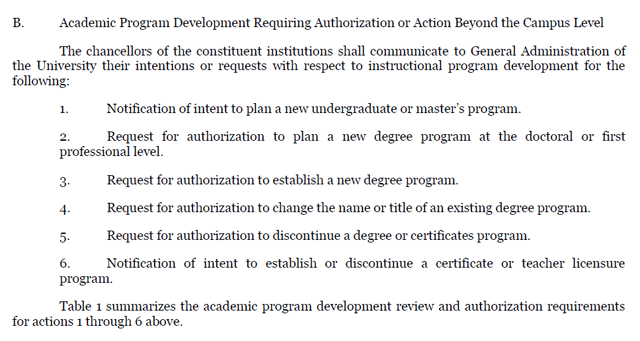
B.UNC Guidelines for Academic Program Development subsection (B). Academic Program Development Requiring Authorization or Action Beyond the Campus Level, states:
The chancellors of the constituent institutions shall communicate to General Administration of the University their intentions with respect to instructional program development:
- Notification of intent to plan a new undergraduate or master's program
- Request for authorization to plan a new degree program at the doctoral or first professional level.
- Request for authorization to establish a new degree program.
UNC Policy Manual 400.1.1,1[G] amended 05/06/09 http://www.northcarolina.edu/aa_planning/degrees/index.htm
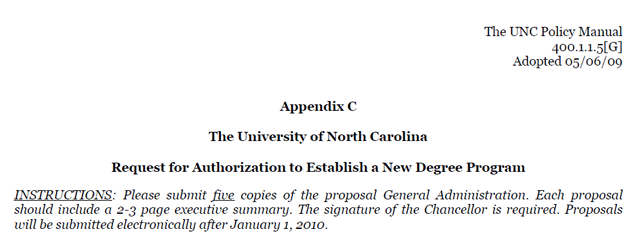
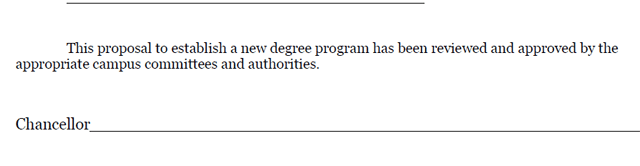
The Nanoscience discipline filed lacked an UNC Chancellor Dr. Linda Brady signed request to establish stand alone UNCG MS and Ph.D. in Nanoscience. Public Record Request (PRR) to Dr. David H. Perrin UNCG Provost & Executive Vice Chancellor,1/7/11, for a copy of an UNCG chancellor signed request to establish stand alone Masters and PhD Nanoscience degrees at UNCG, Counsel Steve Serck responded "In response to your request of 1/7/11, no such documents as you described exists." (Emphasis added). UNCG Chancellors Dr. Linda Brady signature was required pursuit Guidelines for Academic Program Development subsection (B) certifying the proposal to establish a MS and Ph.D. Nanoscience degree programs had been reviewed and approved by the appropriate campus committees and authorities. Lack of her signature on the M.S. and Ph.D. Nanoscience proposals has to be dispositive to Nanoscience_Prospectus.pdf statement: “The Professional M.S. and Ph.D. in Nanoscience degree proposals went through the NC A&T process and the UNCG process prior to submission for approval to the General Administration of the UNC System.”
C.
Ms. Worthington(GA) responded to a public record request for a UNCG Chancellor signed request to plan and establish a PhD in Nanoscience said: “Dr. Alan Mabe in his capacity as Senior Vice President for Academic Affairs determined:
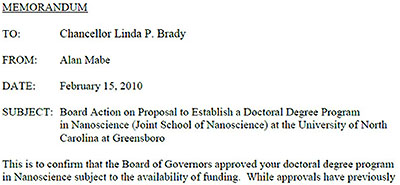
· UNCG was not required to submit a new request to plan a Ph.D. in Nanoscience. The joint proposal submitted by UNCG and NCA&T was deemed sufficient for the campus to move forward with planning a stand- alone degree program. emphasis added
· UNCG was not required to submit a new request to establish a Ph.D. in Nanoscience. The joint request submitted by UNCG and NCA&T, which had already been recommended for approval by the UNC Graduate Council, was deemed sufficient for Board consideration. The Board of Governors concurred with that determination in approving the establishment of the program. (E-mail 10.08. 2010)
Dr. Alan Maba’s statements the joint proposal submitted by UNCG and NCA&T was deemed sufficient for the campus to move forward with planning a stand- alone degree program, UNCG was not required to submit a new request to establish a Ph.D. in Nanoscience, and the joint request submitted by UNCG and NCA&T, which had already been recommended for approval by the UNC Graduate Council, suggest the stand-alone Ph.D. Nanoscience authorization wasn’t founded in a proposal that “ went through the NC A&T process and the UNCG process prior to submission for approval to the General Administration of the UNC System.” UNCG described in Nanoscience_Prospectus.pdf.
Early in the investigation of lack of supporting documentation for UNCG Nanoscience degree authorizations Dr. James Sadler Associate Vice President for Academic Planning University of North Carolina put forth a chronology of authorizations (e-mail (08/04/2010).
October 7, 2009
Dean Ryan was told that UNCG needed to submit a revised request to
establish. Both the original and the revised requests are available
at this site: http://www.northcarolina.edu/dpanels_archive/index.php.
Emphasis added
November 13, 2009
UNC Board of Governors authorizes the UNCG MS in Nanoscience based on
the revised request submitted. The summary that went to the Board
can be viewed in the Planning Committee pre-meeting materials at this
location: https://www.northcarolina.edu/bog/index.php. Emphasis added
December 9, 2009
UNC Graduate Council recommends authorization of the joint PhD.
Emphasis added
January 8, 2010
UNC Board of Governors authorizes the UNCG PhD in Nanoscience based
on the revised request submitted. The summary that went to the
Board can be viewed in the Planning Committee pre-meeting materials at
this location: https://www.northcarolina.edu/bog/index.php. Emphasis
added
Public Record requests to Dr. David H. Perrin and Dr. James Ryan revealed Dr. James Ryan, an UNCG& NCA&T employee, created a PDF titled Nano_master's_degree_proposal_-_Revised_10-9-09.pdf and submitted it to Dr. James Sadler Associate Vice President for Academic Planning University of North Carolina dated two days after a Videoconference panel discussion of the proposed M.S. in Nanoscience, Oct. 7, 09. Dr. Ryan’s Nano_master's_degree_proposal_-_Revised_10-9-09.pdf the same/similar to the UNCG Revised Proposal in the Master of Science in Nanoscience (MS) discipline file at www.northcarolina.edu.
From: James C. Sadler
Date: Sun, Oct 11, 2009 at 10:07 AM
Subject: Re: Revised version of the Request to Establish the
Professional Master of Science in Nanoscience degree program
To: James Ryan CC dhprrin,
JCPETER, altont,
kmurray
Thanks Jim, I’ll confer with Alan about the Ph.D. and whether anything it needed. Jim Sadler
James Ryan wrote:
I have attached a revised version of the Request to Establish for the Professional Master of Science in Nanoscience. I have included the most recent update of the JSNN Management Agreement as well as revised figures on enrollment. I have also provided additional explanation to address questions that were asked during the disciplinary committee review on Wednesday. Please review and let me know if additional information or clarification is needed. Also, similar revisions are needed for the Request to Establish the Ph.D. in Nanoscience. Should I send the latest version of that document to you as well? Thank you. Jim
Dr. James Ryan may have acted outside scope of his employment, created and submitted to the Bowles UNC-GA PDF titled Nano_master's_degree_proposal_-_Revised_10-9-09.pdf whose summary the Bowles UNC-GA carried to the BOG resulted in authorizations of Professional Master’s (Nov. 2009) and Ph.D. ( Jan. 2010) in Nanoscience degrees at UNCG. “The proposal would have been submitted on behalf of the campus via the UNCG’s provost office. You would need to contact that office to clarify what individual(s) developed the documents.” said Ms. Worthington, VP for Communications UNC-GA (e-mail Jan.21, 2011). Emphasis added. Repeated Public Records requests though UNCG Counsel Serck at UNCG to Dr. David H. Perrin UNCG Provost & Executive Vice Chancellor has not confirmed Dean Ryan creation and submission of PDF Nano_master's_degree_proposal_-_Revised_10-9-09.pdf was acting within the scope of his employments. Checking on line the UNCG faculty Dr. James Ryan was listed as a Dean at both universities and not in the Provost office at UNCG or NC A&T.
Clearly, Dr. James Sadler chronology of authorizations and subsequent addition information raises a Red flag to the notion “The Professional M.S. and Ph.D. in Nanoscience degree proposals went through the NC A&T process and the UNCG process prior to submission for approval to the General Administration of the UNC System.” As stated in the Nanoscience_Prospectus.pdf.
. An e-mail received pursuant public Records with the subject Joint Nano discussion on Tuesday may indicate
Subject: Joint Nano Discussion on Tuesday Date: Mon, 27, Oct. 2008 From Ginger Burks, to: Mabe, Ginger Burks, Harold Martin, Scott Jenkins, Rob Nelson CC: Lisa Adamson We are scheduled to discuss the Joint Nanosciences and Nanoengineering proposal at 11 am on Tuesday (Conference Room A). I’ve attached the latest version of the documents for your review. Perhaps we can modify these to denote our agreement on all these topics and then sent to the campuses for final sign off … emphasis added
Part II
The chancellors of both universities formulated and executed the management agreement stipulating the organizational principles, approaches and protocols for JSNN. Nanoscience_Prospectus.pdf emphasis added
A.
HBCU North Carolina Agricultural and Technical State University (NCA&T) and HWWU University of North Carolina Greensboro (UNCG) submitted Joint NCAT/UNCG Requests to Establish Masters ( 01.29.09) and Ph.D. (12.15.08) interdisciplinary Nanoscience degrees pursuant a JSNN Management Agreement ( March 03, 2008) a formal agreement to offer a program of study required by UNC policy for interdisciplinary degrees, Regulations for Academic Program Planning and Evaluation. The Erskine Bowles- UNC-General Administration (GA) referencing a document titled Joint Program Reporting Requirements dated 12/1/08 informed NCA&T and the UNCG the original Memorandum Agreement between the two institutions...is contrary to methods now recommended by General Administration. As such, the Memorandum (Management Agreement) from March 3, 2008 needs to be revised, updated, and reapproved, tabling without consideration by BOG NCAT/UNCG Request’s to Establish Joint Masters (01.29.09) and PhD (12.15.08) interdisciplinary Nanoscience degrees.

B.
The First Amendement (as spelled) to the Amended and Restated Management Agreement was a document submitted to SACS by UNCG whose cover letter clearly demonstrates participation by the General Administration in formulation of managements.
- November 16, 2009 Cover letter: First Amendement (as spelled) to the Amended and Restated Management Agreement Dear Chancellor Brady and Chancellor Martin, Four execution copies of the first amendment to the Amended and Restated JSNN Management Agreement are attached. The amendment changes…….. as Alan Mabe requested. After signature, I will pick up the documents and distribute the signed originals to the UNCG Chancellor’s Office, the NC A&T Chancellor’s Office, UNC General Administration and JSNN. James G. Ryan, Ph.D. emphasis added
C.
JSNN Amended and Restated Management Agreement (April 24, 2008) is the current” formal agreement to offer a program of study” required for interdisciplinary, Regulations for Academic Program Planning and Evaluation at JSNN. NCA&T and UNCG submitted NCAT/UNCG Requests to Establish Joint Masters ( 01.29.09) and Ph.D. (12.15.08) interdisciplinary Nanoscience degrees pursuant a JSNN Management Agreement ( March 03, 2008) in which Nanoscience degrees were to be joint that was disallowed by the Bowles-GA. “Steve has managed the discussion with A&T's and UNCG's provost and the dean of the JSNN so that all issues have been resolved." said Dr. Harold Martin, Sr. (April 9, 2009). Revised JSNN Amended and Restated Management Agreement - April 02, 2009 was managed by the UNC-GA with no indication the chancellors were involved. The BOG authorized UNCG MS ( Nov. 2009) and Ph.D.(Jan. 2010) Nanoscience degrees pursuant JSNN Amended and Restated Management Agreement(April 24, 2008) which says UNCG will offer Nanoscience degrees and NCA&T will offer Nanoengineering degrees. The only Nanoscience Proposal at UNCG in the discipline file is the UNCG Revised Request to establish created and submitted by Dean Ryan dated 10.09.2009 to the UNC-GA.
D.
Subject : Joint Nano Discussion on Tuesday Date: Mon, 27, Oct. 2008 From Ginger Burks, to: Mabe, Ginger Burks, Harold Martin, Scott Jenkins, Rob Nelson CC: Lisa Adamson We are scheduled to discuss the Joint Nanoscience and Nanoengineering proposal at 11 am on Tuesday (Conference Room A). I’ve attached the latest version of the documents for your review. Perhaps we can modify these to denote our agreement on all these topics and then sent to the campuses for final sign off …
Unmistakable items A-D indicate the Erskine Bowles General Administration has a ongoing hand in JSNN Manager Agreements not expressed in the statement “The chancellors of both universities formulated and executed the management agreement stipulating the organizational principles, approaches and protocols for JSNN.” which may conceal role played by the General Administration in formulation of managements agreements.
“Michael”
Pippen, Sr.
webmaster@blacktriadnews.com
Black Triad News Com
3810 Nash Street
Greensboro, NC 27401-4638
336-275-8025 All Rights Reserved
[2] Nanotechnology in North Carolina,
April 2007 North Carolina Biotechnology
Center.
[3] Sharlini Sankaran, NC Technology.com (http://www.ncnanotechnology.com/public/features/UNCG-
NCAT.asp}
[4] PCG/UNC/NCCCS/HB1264UNC Final Recommendations.doc/BS.PC.3.SP.8/AP.4/CC.11/21July06
[5] Request to Establish NCA&T/UNCG Joint School of Nanoscience and
Nanoengineering
The CREATOR said of the United States “they have the right form of government but it’s been bastardized.” Here you have the vote but don’t monitor the people you put in power. Power doesn’t regulate itself it has to be regulated. This investigative report using North Carolina Public record laws and the internet demonstrates how true stake holder in the government, the people, can track official acts of elected officials.
Angels Gathered Here: Ain’t darn thing funny when I’m ordered from the background to the foreground. Help somebody else!!! You can’t run with us so stay on the porch.